



The first time IBP comes up, it usually arrives in enterprise language: finance at the planning table and software suites built for large enterprises. Your plan, meanwhile, is kept alive by the same small team that places the purchase orders. Is IBP a bigger S&OP, or a different job altogether? That is the practical question behind S&OP vs IBP: which level of integration does your business need?
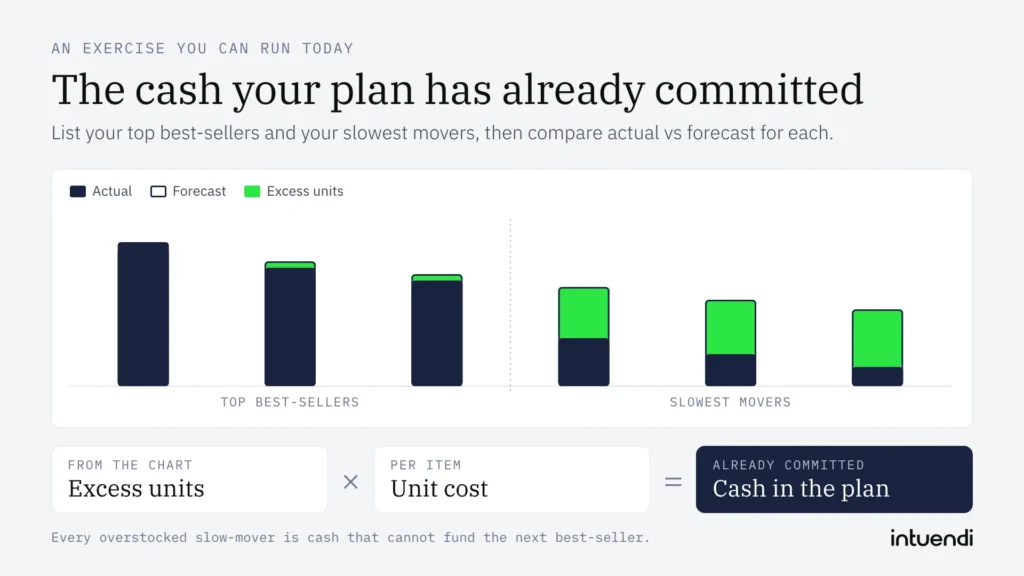
Whichever it turns out to be, the part we would borrow first at your size is the link between stock and cash. Every overstocked slow-mover is cash that cannot fund the next best-seller. For a small or medium-sized business, that link depends far more on clean sales and stock data than on another monthly meeting. Build it and purchase orders start reflecting the budget. Leave it out and purchase orders keep setting the budget instead.
Difference between S&OP and IBP at a glance: scope, horizon, ownership and metrics
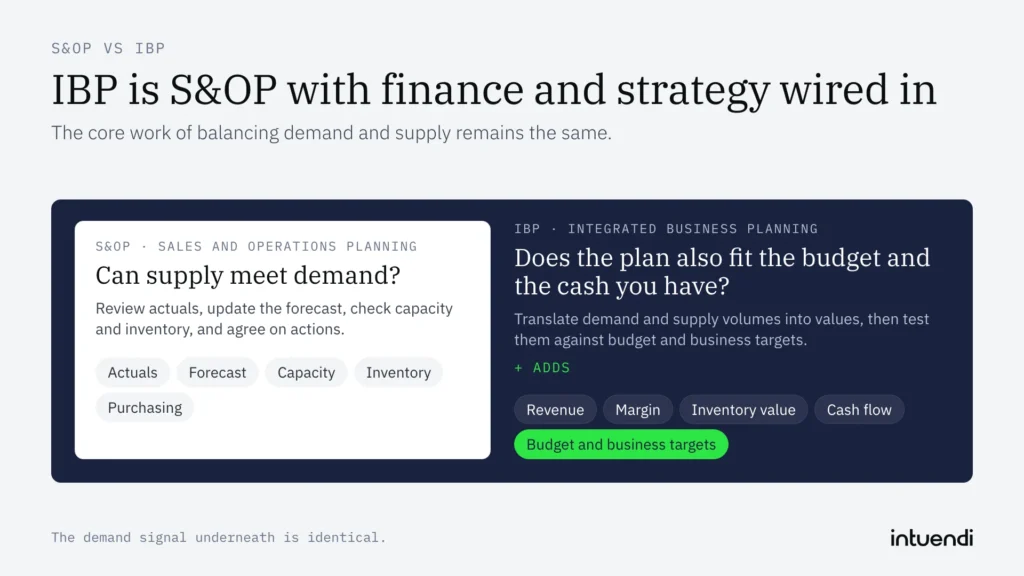
The short answer: IBP is S&OP with finance and strategy wired in. S&OP asks whether supply can meet demand. IBP asks whether that plan also fits the budget and the cash you have. So yes, it is a broader process positioned at a higher decision level, but the core work of balancing demand and supply remains the same.
S&OP and IBP differences: a side-by-side comparison
| Dimension | S&OP | IBP |
|---|---|---|
| Objective | Align demand and supply | Align the operating plan with strategy and finances |
| Scope | Sales, marketing, operations, finance (review) | Same, plus budget, cash flow and strategic goals |
| Horizon | Rolling medium-term horizon, monthly cycle | Weighted toward the strategic, budget-driven view |
| Ownership | Supply chain or operations lead, with final decisions at executive level | Executive and finance-level sponsorship |
| Metrics | Forecast accuracy, service level, stock levels | Those, plus revenue, margin and cash against plan |
| Financial integration | Partial, often a review step | Built into every cycle |
| Output | One consistent operating plan | An operating plan reconciled with the financial plan |
The table shows that IBP does not change the forecast itself: the demand signal underneath is identical. It changes how many people must agree before a number becomes the plan.
S&OP vs IBP benefits: what each model delivers
Take one problem: a promotion pushes a best-seller well above forecast, and your supplier has a minimum order quantity and a long lead time. In an S&OP meeting, the question is operational. Do we raise the purchase order, can the supplier deliver in time, and which channel gets priority if stock runs short?
An IBP cycle asks those questions and then adds three more. What does the larger order do to inventory and working capital? What happens to margin if the promotion underperforms? Does the budget allow it at all? You get scenarios with and without the promotion, each tied to cash, service level and capacity.
That is the real benefit gap. S&OP protects availability; IBP protects availability and the financial plan together. The price is more people, more preparation and more places for the process to stall, which we cover in our piece on S&OP challenges.
S&OP IBP meaning: how the two processes work in practice
Use Sales and Operations Planning (S&OP) as a recurring cycle to align demand with supply. You review actuals, update the forecast, check capacity and inventory, and agree on actions. You can involve Sales, operations, purchasing and, where useful, Finance; your aim is one feasible plan for what to buy, produce and stock.
With Integrated Business Planning (IBP), you add a financial and strategic layer to the same operating plan. You translate demand and supply volumes into revenue, margin, inventory value and cash flow, then test them against budget and business targets.
Both processes need reliable SKU-level sales history, current stock and lead times. Their shared output is a plan that drives replenishment decisions and guides action. For a small team, comparing actual vs forecast, setting target coverage by SKU and estimating cash tied up in slow-movers creates much of the discipline behind IBP.
S&OP meaning: five core stages
Treat this five-stage core cycle as a practical framework: you can combine stages in a single meeting. Data gathering prepares the five core stages, while execution and review follow them, turning demand, supply and financial constraints into one executable plan.
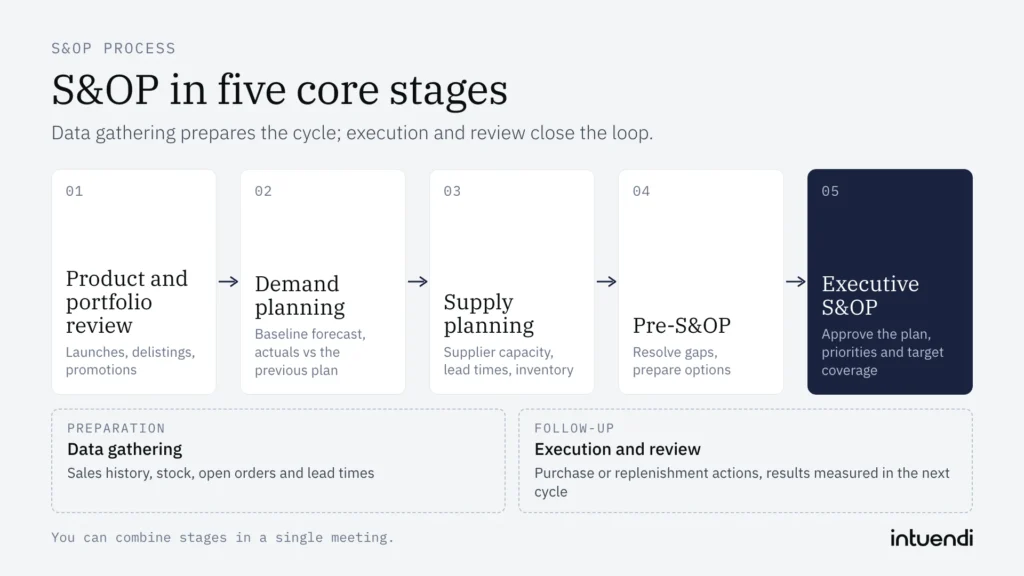
- Data gathering (preparation): collect sales history, stock, open orders and lead times.
- Product and portfolio review: assess launches, delistings, promotions and portfolio changes that may affect demand or supply.
- Demand planning: create a baseline forecast and compare actuals with the previous plan.
- Supply planning: test supplier capacity, lead times and inventory against demand.
- Pre-S&OP: resolve gaps and prepare options with their service, cost and capacity effects.
- Executive S&OP: approve the plan, priorities and target coverage; Finance may also validate budget implications.
- Execution and review (follow-up): convert decisions into purchase or replenishment actions, then measure results in the next cycle.
Execution and review close the loop. They let you trace misses to a promotion, supplier delay or demand shift, improving forecast accuracy over time. For a smaller team, the first three core stages can run in an ERP or spreadsheet, while automation frees the team to focus on the trade-offs in the review meetings.
Integrated business planning (IBP): financial integration and scenario planning
You use integrated business planning (IBP) to connect the operating and financial plans. Demand and supply volumes carry values for revenue, margin, purchase cost and inventory. When the plan changes, its effect on the P&L, budget and cash forecast becomes visible. The question is not only “can we ship it?” but also “can we afford to buy it?”
Financial integration does not require a complex model. Finance and supply chain can review:
- Forecast revenue and margin from the SKU-level demand plan
- Projected inventory value against target coverage
- Open purchase commitments and payment timing
- Actual vs forecast gaps explained by volume, mix or timing
Scenario planning tests the consequences before the decision is locked. Model a best-seller growing faster than forecast, a supplier lead time extending, or a promotion pulling demand forward. Each scenario should show the effect on stock-outs, overstock, service and cash. Two or three focused scenarios are usually enough; beyond that, the meeting risks becoming a modeling exercise.
A scenario built on incomplete sales history, outdated stock or unreliable lead times can look precise and still send the plan in the wrong direction. That is why you need a connected view of the data: an AI-powered planning tool like Intuendi can connect to an ERP via API, generate SKU-level forecasts and replenishment suggestions, and compare scenarios without rebuilding spreadsheets. Your team keeps control of the assumptions while spending less time reconciling data.
S&OP or IBP: which model fits your business?
IBP is not automatically the grown-up choice. It earns its overhead when complexity demands it, and for many companies it does not.
S&OP or IBP process: criteria for choosing
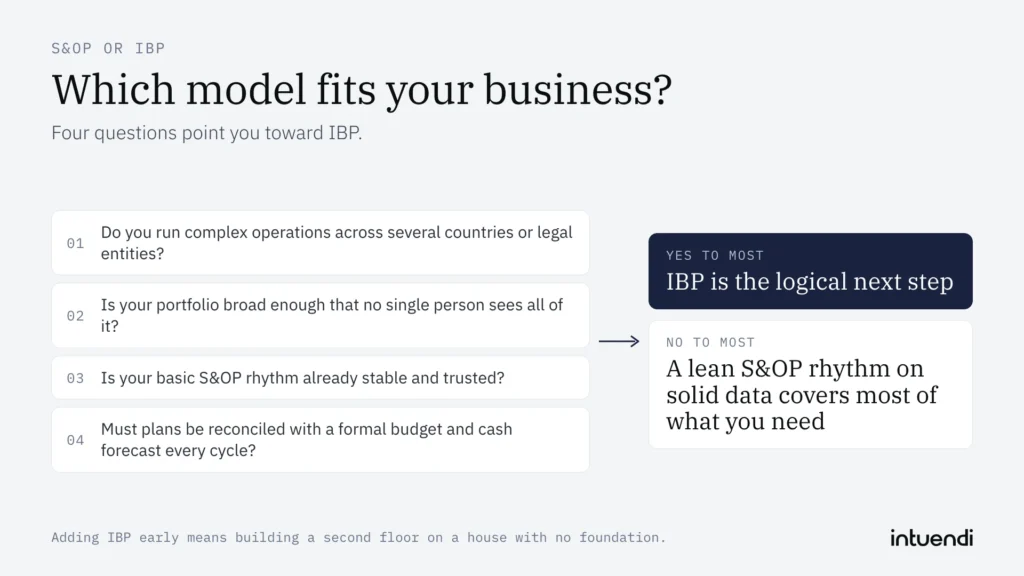
Four questions make the S&OP vs IBP decision clearer and point you toward IBP:
- Do you run complex operations across several countries or legal entities?
- Is your portfolio broad enough that no single person sees all of it?
- Is your basic S&OP rhythm already stable and trusted?
- Must plans be reconciled with a formal budget and cash forecast every cycle?
If you answer yes to most, IBP is the logical next step. If you answer no to most, adding it early means building a second floor on a house with no foundation.
For an SME, IBP is a data problem, not a meeting problem
For a small or medium-sized business, the person who forecasts often also buys and talks to finance. A formal cross-functional cycle there is mostly overhead: meetings that repeat conversations already happening at the desk. Enterprise suites carry a steeper learning curve and a heavier implementation effort, which a small team rarely has spare.
What IBP promises is a link between stock decisions and cash. That is achievable without the meeting machinery, because it depends on data: clean sales by SKU, current stock, open purchase orders, real lead times, and a target coverage that reflects your budget. Add automated reorder suggestions and the financial check happens in every purchase order instead of once a month.
Here is an exercise you can run today. List your top best-sellers and your slowest movers, then compare actual vs forecast for each. Multiply the excess units by unit cost. That figure is the cash your plan has already committed. Our demand planning KPI guide shows which indicators to track from there.
The honest limit: if you operate globally or answer to investors who want a formal budget reconciliation, you will outgrow this shortcut, and the criteria above will tell you when. Until then, a lean Sales and Operations Planning (S&OP) rhythm on solid data covers most of what you need.
When a lean S&OP rhythm stops being enough
Once the criteria above start returning yes, the data-first shortcut will not hold. A structured IBP process with executive and finance-level sponsorship is the right investment. Other small and medium-sized businesses can run a quicker test today: pull your open purchase orders and set each one against current stock and real supplier lead times. Then count how many would push a slow-mover past the coverage your open to buy budget can carry.
At Intuendi, you get reorder suggestions based on sales by SKU, current stock and real lead times, with MOQ, budget limits and packaging units taken into account. This gives you a practical starting point for moving from data-backed replenishment to a more structured process. You can connect the relevant systems through ERP integrations; first stabilise your S&OP rhythm, then build IBP when the added financial and strategic governance is justified. See Intuendi in action when you are ready to connect planning with execution.
Not exactly. IBP typically builds on S&OP by connecting operational plans more systematically with financial targets, strategic priorities and scenario-based decisions. However, mature S&OP processes can already involve Finance. The distinction is primarily about the depth of integration and decision-making, not simply having more meetings or more sophisticated software.
S&OP is tactical. It sets volume, inventory and purchasing plans for the coming months. S&OE (Sales and Operations Execution) works in the short term, from days to weeks. It handles stockouts, late supplier deliveries and urgent reallocations within the agreed plan. S&OP sets the course, and S&OE keeps you on it when reality deviates.
Consider moving toward IBP when planning decisions require closer alignment between demand, supply, finance and strategic priorities—for example, across multiple markets, frequent product launches or significant working-capital constraints. First ensure your S&OP process has reliable data, clear ownership and an established planning cycle. IBP builds on that foundation rather than replacing it.
Not necessarily. A lean IBP step can start with your existing planning data plus a finance view. Enterprise suites such as SAP IBP offer broad capabilities, but they come with a steeper learning curve and a heavier implementation effort, which may be a burden for smaller companies. Choose tools after the process is defined.
Typical errors include rebranding S&OP without changing decisions, adding finance meetings without shared data, buying enterprise software before the process is stable, and having no clear plan owner. Another mistake is building too many scenarios for a small team. Start with a few decisions that really affect cash and margin.
