



A supplier asks for next season’s order before you’ve worked out what you can afford, and on screen are last year’s sales, a warehouse stock count and the purchase orders still in transit. What’s missing is the number that ties them together: how much you can spend without running out of best-sellers or piling up slow-movers. What we see most often is last year’s order, plus a little, and a glance at the bank balance.
The number missing from that screen is called open to buy. It comes from figures you already track, and it turns a supplier deadline into a budget per month and per category. Build it on a solid sales forecast and every order has a reason behind it. Build it on a guess and the budget looks precise while funding the wrong products.
Open to buy meaning in retail and why it matters
Search “open to buy” and you will also land on gambling, credit offers and Best Buy opening hours. None of that applies here. In retail inventory planning, open to buy is a purchasing limit that answers one question: how much more can you buy without breaking your plan?
Open to buy definition: OTB budget and inventory management
What is open to buy in retail? It is the amount you can still invest in inventory while keeping planned sales, stock levels and financial targets intact. Your open to buy budget is not a pot of cash. It links the sales you expect, the stock you want to hold and the stock you already own or have ordered.
How an open to buy system in retail works
Each period, you forecast sales and set the stock you want at period end. You then subtract what is on the shelf and what is in transit, and the remainder is your room to buy. Every purchase order either fits inside that room or waits, which is how the budget protects the wider purchasing process from impulse orders.
Open to buy calculation: how to work out your OTB budget
The open to buy calculation is plain arithmetic. The hard part is the inputs, especially the first one.
The open to buy formula at retail and the open to buy at cost formula
The open-to-buy formula is:
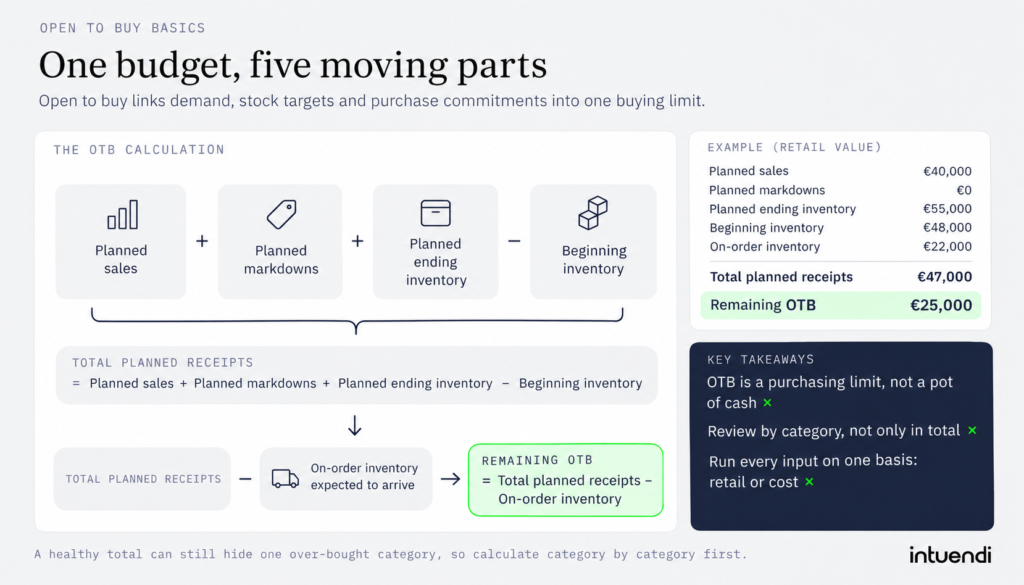
Total Planned Receipts = Planned Sales + Planned Markdowns + Planned Ending Inventory − Beginning Inventory
Remaining OTB = Total Planned Receipts − On-Order Inventory
Planned sales are your forecast for the period, planned markdowns are the reductions expected during it, and planned ending inventory is the stock you want left at the end. Beginning inventory is what you hold today. Total planned receipts show how much inventory must be received during the period; remaining OTB shows how much is still available after existing purchase commitments expected to arrive. Run both calculations entirely at retail value or entirely at cost value. Never mix the two bases.
Open to buy example with real numbers
Here is an illustrative month, at retail value:
- Planned sales: €40,000
- Planned ending inventory: €55,000
- Beginning inventory: €48,000
- Planned markdowns: €0
- On-order inventory expected to arrive: €22,000
At retail value, total planned receipts are €40,000 + €0 + €55,000 − €48,000 = €47,000. After subtracting the €22,000 already on order, the remaining OTB is €25,000. This is a retail-value result. A cost-value OTB requires every input to be converted and calculated at cost; if all inputs were consistently 50% of retail value, the remaining OTB would be about €12,500 at cost. Calculate it category by category first, then review the total. A negative result in one category means you are already over-bought there; it does not free budget elsewhere, and a healthy total can hide that problem.
What moves your open to buy forecast: sales, markdowns and on-order stock
Raise the sales forecast by 10% and the example gives €29,000. Add €8,000 to on-order stock and it falls to €17,000. A higher ending-stock target pushes the budget up, a fuller warehouse pulls it down.
Planned markdowns need care. Include them explicitly in the retail-value formula because they increase the receipts required to reach the planned ending inventory after reducing selling value. Keep the retail-value calculation separate from cost-value OTB.
Of the four inputs, two are counts and one is a target you set. The sales forecast is the only estimate, so it deserves the most attention. Good inventory planning starts there.
Open to buy planning: turning the OTB plan into a weekly routine
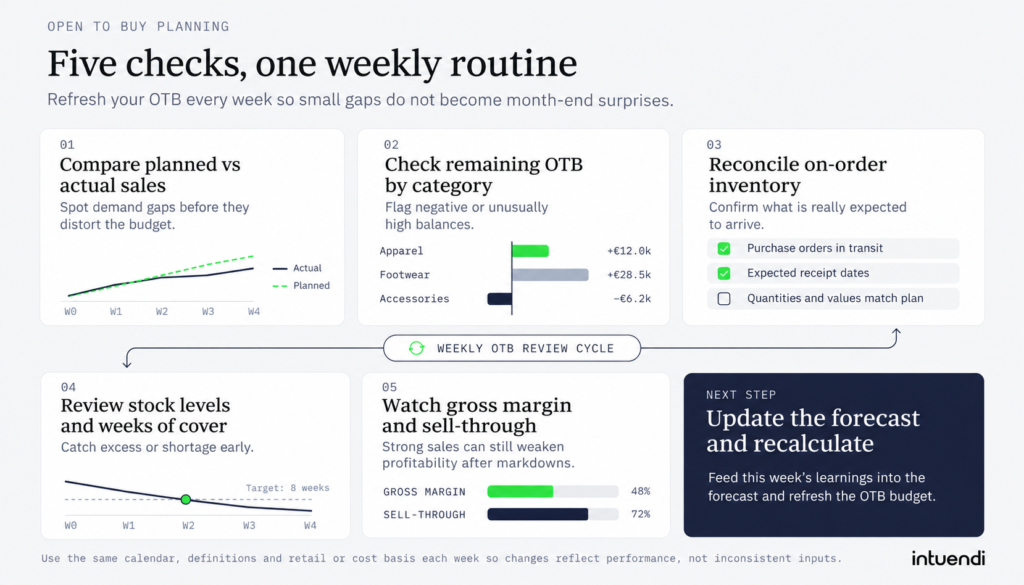
For fast-moving or volatile categories, a monthly budget can go stale within days. Open to buy planning works when you compare planned and actual sales every week, update the forecast and recalculate. Then you correct a small gap in week two instead of finding a large one at month end.
Open to Buy Management: The KPIs to Track Every Week
- Actual versus planned sales: Spot demand gaps before they distort the budget.
- Remaining OTB budget: Review the balance by category and flag negative or unusually high amounts.
- On-order inventory: Reconcile incoming stock with confirmed purchase orders so it does not quietly consume future buying room.
- Inventory levels: Compare stock with target levels and weeks of cover to catch excess or shortage early.
- Gross margin and sell-through: Check whether sales are supporting profitability, especially after markdowns.
Use the same calendar, definitions and retail or cost basis each week, so changes reflect performance rather than inconsistent inputs.
Open to Buy in Excel: Spreadsheet Setup and Limitations
To set up an open to buy spreadsheet, use one row per category and one column per week or month. Include the five inputs, an OTB formula, an actual-versus-planned block and a chart. Start from your assortment plan, so each category’s budget matches the range you intend to sell.
The spreadsheet’s limitations show up fast. Formulas get overwritten, versions multiply, and one person ends up maintaining the file. If you sell through one channel and one warehouse with a stable range, a spreadsheet may be all you need.
Open to buy software: when OTB Excel templates stop scaling
The template starts to strain with several channels, promotions, launches without history and a weekly forecast refresh. At that point, your team needs a specialised engine that turns demand forecasts and stock targets into purchase proposals. Intuendi supports a transparent Actual versus Forecast comparison and leaves the final decision with your team.
Test your open to buy on one category before trusting it
In the example, a 10% change in the sales forecast moved the budget from €25,000 to €29,000. We can’t tell from here how far your own forecast drifts from actual sales, yet that drift determines whether your OTB budget is a plan or a guess. You can check it today with data you already have. Take your largest category and run the formula with last month’s planned sales, then with the actual figure. The gap between the two results is the money your forecast moved.
One channel, a stable range and a small gap: the spreadsheet is doing its job. If the gap is wide, or different on each channel, a spreadsheet may no longer hold the comparison together. You can request a personalised demo built around your business to see how Intuendi could fit your planning process, with no contract or integration required.
To calculate open-to-buy, you need planned sales, planned ending inventory, beginning inventory, and stock already on order, all measured for the same period and on a consistent retail or cost basis. For retail-value OTB calculations, include planned markdowns among the inputs. Use accurate sales forecasts and up-to-date inventory and purchase order records, ideally by product category and planning period. Supplier lead times, minimum order quantities, and margins also influence purchasing decisions, but they are planning considerations rather than direct inputs to the basic OTB calculation.
A merchandise plan is the strategic, usually seasonal or annual, budget. It sets targets for sales, margin, markdowns, inventory levels and purchases by category. Open-to-buy is the operational control that tracks how much of that purchasing budget is still available as the period unfolds. In short, the merchandise plan says what you intend to do, and OTB shows what you can still do given actual sales, stock and orders. The plan changes rarely, while OTB is recalculated regularly. Together they connect your high-level financial goals with day-to-day purchasing decisions.
At minimum, review OTB monthly, since the classic formula works on monthly periods. Most retail and ecommerce SMEs get better results with a weekly update, especially for fast-moving categories, seasonal peaks or products with short lead times. Update it immediately when something significant changes: a promotion, a supplier delay, a new purchase order, a stock adjustment or a sharp shift in sales. Frequent updates keep the numbers close to reality, so you can correct course before overstock or stockouts build up. Automating data feeds from your inventory and order systems makes a higher frequency realistic for a small team.
When actual sales differ from the plan, recalculate your open-to-buy using updated sales forecasts, current inventory, outstanding purchase orders, and target ending inventory. If sales are higher than expected, review whether additional purchasing is justified by sustained demand, supplier lead times, margins, and available budget. If sales are lower than planned, consider delaying or reducing future orders, reviewing excess stock, and adjusting the remaining sales forecast. The goal is to keep purchasing aligned with actual demand without creating unnecessary overstock or increasing stockout risk.
The most frequent mistakes are: relying on inaccurate inventory or purchase order data; ignoring stock already on order or its delivery dates; using an unrealistic sales forecast with no seasonality or promotion effects; mixing retail and cost values in the same calculation; planning only at total level instead of by category; and updating OTB too rarely. Another common error is treating OTB as a target to spend rather than a limit. Unused OTB is not lost; it can protect cash for better opportunities. Finally, many teams forget to include lead times, so orders arrive too late to match the planned period.
