Forecast demand and turn it into a plan your whole team can act on.
Intuendi combines AI-powered demand forecasting with promotions, seasonality and external factors, and connects the forecast to inventory and purchasing decisions. Sales, finance and supply chain plan from the same numbers.
What demand planning software changes
More accurate forecasts
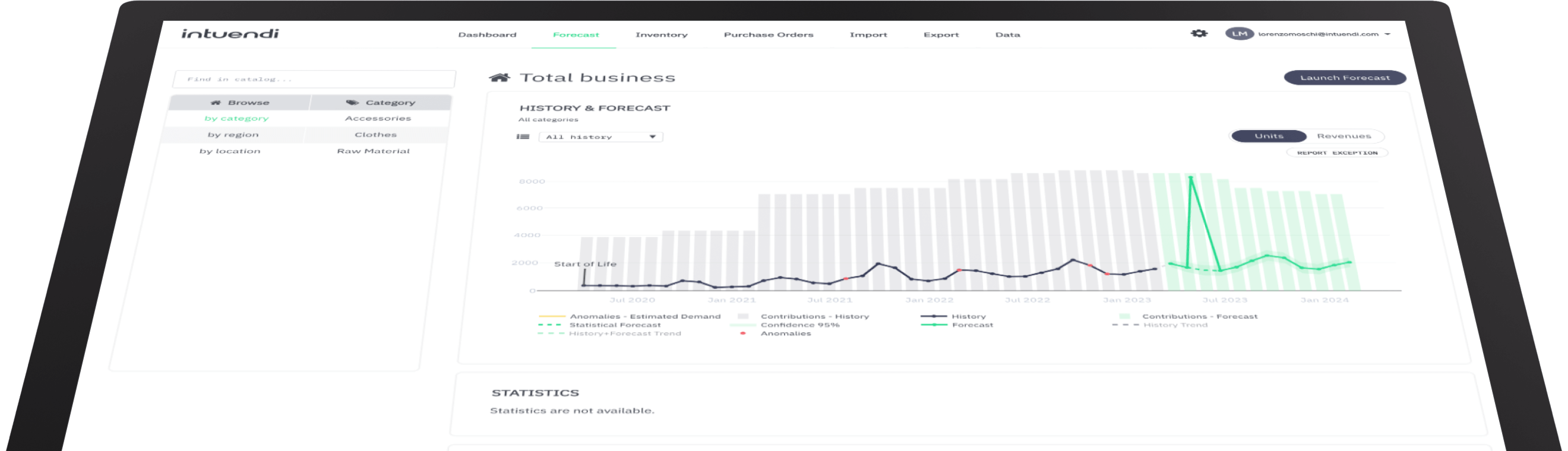
AI and statistical methods read your sales history together with seasonality, holidays and promotions. Every forecast includes a probability band that shows how certain it is.
Stock where demand is
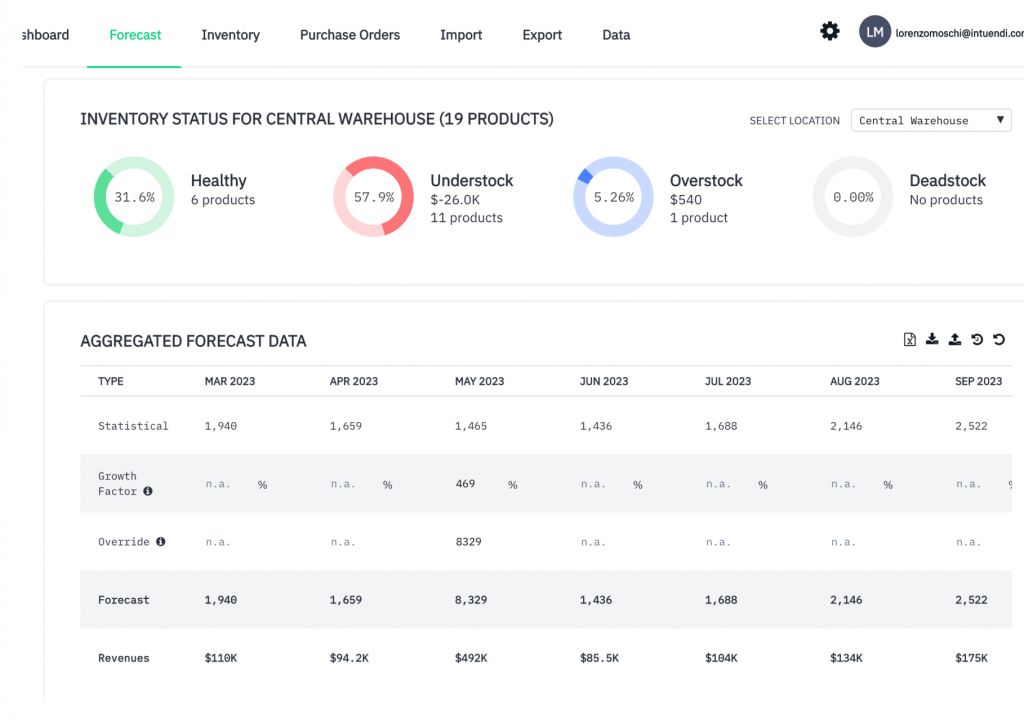
Plan stock around expected demand to prevent stock-outs on best-sellers and excess inventory on slow movers, across products, channels and locations.
One plan for every team
Sales, marketing and finance add their insight to the same forecast and agree on one demand plan that purchasing can follow.
Early signals, every day
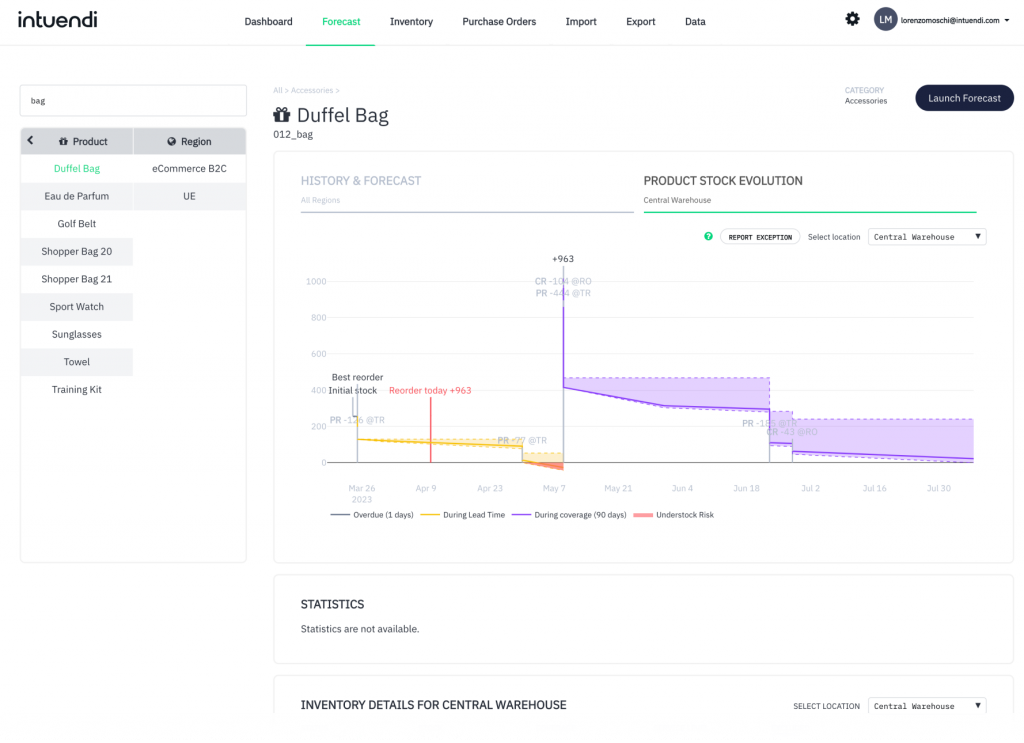
Intuendi monitors stock levels every day against the forecast, so products at risk of a stock-out or building up excess show up while there is still time to act.
FORECAST & PLAN
From the forecast to a shared demand plan.
The demand planning capabilities in Intuendi, in one workflow.
Forecasts at every level
Explore demand by product, category, channel and location, from the total business down to a single SKU. New products are estimated from similar past launches.
Promotions, events and external factors
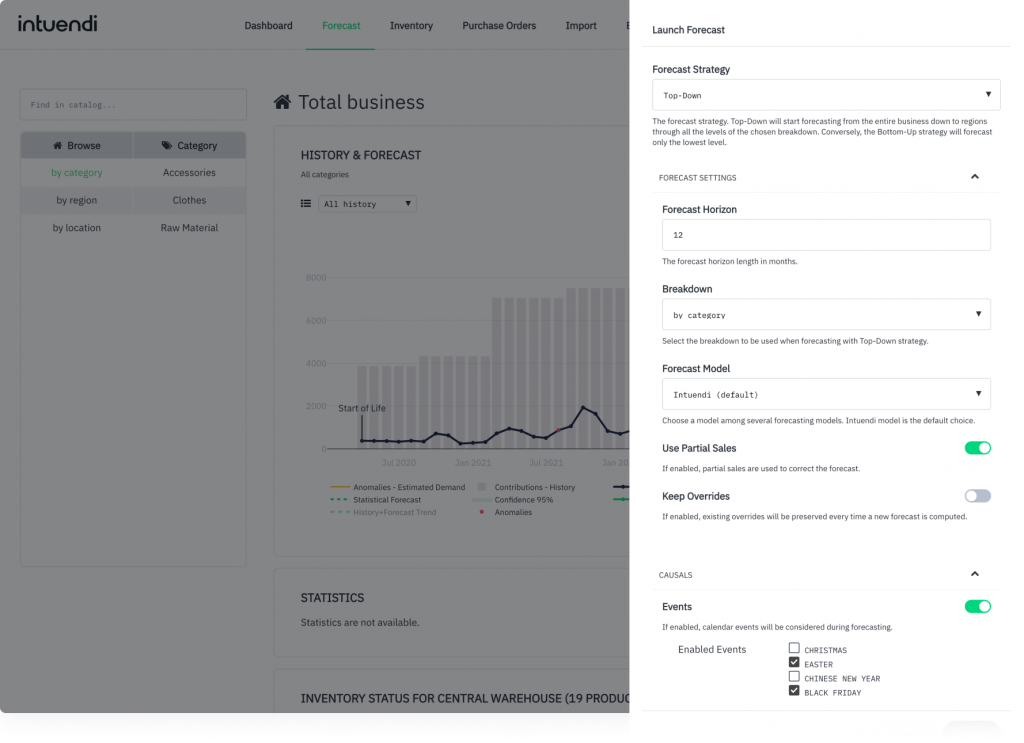
Past promotions and stock-outs are cleaned from your sales history, planned promotions and events are added to the forecast, and external factors such as marketing campaigns or weather can be measured and included.
Consensus demand planning
Teams review the forecast and apply overrides at any level. Finance can set targets in revenue, and Intuendi converts them into the units the plan needs.
INTRODUCING
Symphonie is Intuendi’s in-app AI assistant for supply chain planning. Ask questions about your data, explore demand and inventory insights, and get support when reviewing forecasts or refining your plan.
"The software is easy to use, saves a lot of time which can be better invested, the inventory graphics are really helpful.”
Juan Raúl Gómez
Regional Procurement Manager, Casa de las Baterias
Connect demand planning to the rest of your supply chain
Bring demand forecasting, inventory optimization and order planning together with Intuendi.
Inventory
Get the right replenishment at the right time with real time visibility of your inventory
Orders
Our PO functionality is here for a faster and unmatched purchasing workflow.
Symphonie
The in-app AI intelligence layer that turns your supply chain data into decisions.
Inventory
Get the right replenishment at the right time with real time visibility of your inventory
Orders
Our PO functionality is here for a faster and unmatched purchasing workflow.
Symphonie
The in-app AI intelligence layer that turns your supply chain data into decisions.
Here to help you, also to understand
What is demand planning software?
Demand planning software forecasts the demand for your products and turns it into a plan for inventory, purchasing and production. It combines sales history with seasonality, promotions and the other factors that move demand.
Demand planning or demand forecasting?
Demand forecasting estimates future sales. Demand planning uses that forecast, together with your teams’ knowledge and business targets, to decide how much stock to hold and what to buy.
How does AI improve demand planning?
AI reads patterns across thousands of products and channels at once, separates promotions and stock-outs from real demand and estimates new products from similar launches. Planners review the result and add what the data cannot know.
Intuendi forecasts demand for every product, channel and location, and connects the forecast to inventory targets and to suggested purchase, production and transfer orders.
Accuracy depends on your data, from the variability of your sales history to the external factors that affect it. Intuendi shows a probability band for every forecast and lets you compare forecast and actual sales over time.
Intuendi supports integrations with ERP systems and other business data sources through options including APIs and file exchange. Explore our integrations to identify the available connection options for your systems.
Businesses that sell many products across channels or locations, with seasonal demand, frequent promotions or regular launches. Intuendi is built for small and mid-sized retailers, brands and distributors.
Yes. Excess stock and deadstock are flagged with the value tied up in each product, and coverage settings keep orders closer to expected demand.
We use cookies to improve the experience on our site. Read the privacy policy.
Functional
Always active
The technical storage or access is strictly necessary for the legitimate purpose of enabling the use of a specific service explicitly requested by the subscriber or user, or for the sole purpose of carrying out the transmission of a communication over an electronic communications network.
Preferences
The technical storage or access is necessary for the legitimate purpose of storing preferences that are not requested by the subscriber or user.
Statistics
The technical storage or access that is used exclusively for statistical purposes.The technical storage or access that is used exclusively for anonymous statistical purposes. Without a subpoena, voluntary compliance on the part of your Internet Service Provider, or additional records from a third party, information stored or retrieved for this purpose alone cannot usually be used to identify you.
Marketing
The technical storage or access is required to create user profiles to send advertising, or to track the user on a website or across several websites for similar marketing purposes.