



A late purchase order is worth chasing when projected demand indicates a shortage before the revised arrival date and the product is still selling. A safety-stock breach is one possible trigger, not a universal requirement. Yet the open PO book usually gets worked top to bottom. Every delay looks urgent, supplier updates scatter across email threads, and orders the forecast no longer needs keep sailing toward your warehouse.
Treating every late line as urgent costs you twice: the chase eats your week, and cash freezes in arrivals that no longer match demand. Start with demand, not the delay, and expediting works in both directions. You pull forward only the lines that protect a best-seller, push out or trim what the forecast has dropped, and ask suppliers for both without spending goodwill you will need next quarter.
Expediting meaning in procurement and how it differs from purchasing
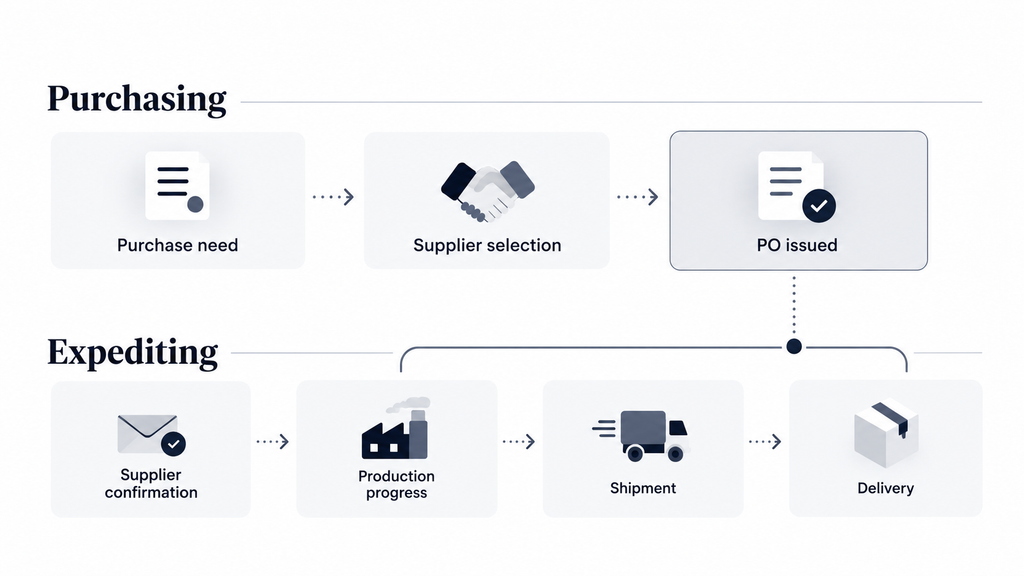
Purchasing ends when the order leaves your outbox. Expediting starts at that moment, with a different clock and a different question: will this order arrive when we need it?
What does expediting mean in procurement?
Expediting in procurement is proactive follow-up on an open order. It checks that materials, documents and shipments arrive on time and in full, and it closes issues before they reach your shelves. The purchasing process decides what to buy and from whom. Expediting watches the purchase order being executed.
The importance of expediting in procurement
Without it, you learn about a delay when the stock is already gone. Updates make it worse: one confirmation can arrive three times, in three formats, and still not give you the date that matters. Good expediting reduces all that noise to one question per line: will projected stock fall below safety stock before the revised arrival date, and is the product still selling?
The procurement expediting process from purchase order to delivery
The process follows the order: confirm, monitor, ship, receive. Most advice treats it as one-way pressure on suppliers. Run it as a two-way review, because some lines need a push and others need a pause.
Purchase order expediting: confirmation, supplier follow-up and production monitoring
Start by validating the PO data, then get promised dates confirmed in writing. On lines that matter, ask for production progress, not just a “yes, on track”. The limit is cost. For a low-value item with plenty of cover, a confirmation is enough, and chasing it costs more than the delay would.
Triage rules: when to expedite and when to wait
Expedite when projected demand indicates a shortage before the revised arrival date and the product is still selling. A projected breach of safety stock is one possible trigger, not a universal requirement; if demand does not indicate a shortage or the product is no longer selling, wait.
Take a hypothetical best-seller: 150 units on hand, 40 sold per week, safety stock of 80. The supplier slips a 300-unit order to arrive in week four. Stock drops below 80 in under two weeks, so you expedite. Give a slow-mover the same delay with 300 on hand, 10 sold per week and safety stock of 20, and you wait: projected stock remains well above 20 by week four. Safety stock is one useful reference point, not the only trigger; use the latest demand forecast and business context as well.
Supplier delivery expediting: shipment tracking, customs and delivery
Once goods ship, the work becomes procurement delivery tracking: carrier status, customs documents and a receiving slot. You rarely control customs timing, but you can stop paperwork from being the reason a shipment sits still. Ask for the document pack before departure, not after the delay.
De-expediting: pushing out orders the forecast no longer needs
Forecasts move after orders are placed. When the forecast has dropped, the open line is now excess, and the right move is to push out or reduce it. Compare each open line with the latest forecast every week.
To ask without burning goodwill, ask early, before production starts. Give a new date range and a firm quantity, explain why, and offer something back, such as keeping the next order. Changes travel better in one shared thread than in scattered emails. That is the case for purchase order collaboration. Lines already in production, or tied to minimum order or cancellation terms, may not move, so check the contract first.
The cash effect of a weekly push-out review
Consider a hypothetical 300-unit line costing €12 a unit. Pushing delivery out four weeks delays receipt of the inventory and frees €3,600 of inventory value and storage capacity for four weeks. Any cash-flow saving depends on supplier payment terms, such as payment being due only after delivery.
One line is small. The whole open book is not. We won’t quote a typical saving, because it depends on your orders. Measure your own: postponed payment value × weeks of payment delay × weekly cost of capital or storage.
Expediting that works: KPIs, Tools and the next step for your team
You cannot improve expediting you do not measure. Start with a short set of KPIs that tie supplier behavior to demand: on-time-in-full rate by supplier, the gap between promised and actual arrival dates, and the share of expedite requests that prevented a stock-out. Add one cost-side metric as well, such as the value of open PO lines that no longer match the forecast. Together they show whether you are protecting service or just generating activity.
- Promise-date reliability: how often a supplier’s revised date holds, so you know whose updates to trust.
- Expedite hit rate: the percentage of chased lines that arrived before the projected shortage.
- Orders at risk: open PO lines where projected stock hits zero before the arrival date, ranked by sales impact.
- Excess inbound value: arrivals the forecast no longer needs, which tie up working capital and warehouse space.
Spreadsheets and inbox threads can track these numbers for a while, but they rarely keep up with daily changes. The practical fix is a single view that joins open POs, supplier confirmations and forecast demand at SKU and warehouse level. Intuendi’s AI-powered replenishment suite does this by comparing each order’s arrival date against projected coverage. Planners see which lines to pull forward, which to push out, and which to leave alone. Integration via API with your ERP keeps order data aligned, so the team spends less time reconciling files and more time on supplier conversations that matter.
The next step is small and concrete. Pull your open PO book, flag every line where projected stock runs out before the revised arrival date, and check how many of your current chases would survive that filter. That one review usually shows where the time and cash are going, and it gives your team a shared rule for what deserves a call. If you want to see this on your own data, book a demo with Intuendi and we will walk through your open orders together.
Put your open PO lines through the triage rules
Apply the same forecast-led triage to your open PO book: check whether projected demand indicates a shortage before the revised arrival date, whether the product is still selling, and whether a safety-stock breach is one signal among several—not a mandatory condition. An order management view can show each PO line’s ETA, quantity and cost, alongside inventory status, stock on hand, stock in transit and coverage in days. What-if scenarios for ETA and coverage make the impact visible. You’ll find these in Intuendi’s order management software.
Check supplier terms before you ask. As an exercise, export your open PO lines with promised dates, quantities and unit cost. Then mark the lines whose product forecast has dropped since the order was placed. To see how Intuendi can support this kind of order-management review, book a personalized demo.
Expediting in procurement is the process of actively tracking and accelerating open purchase orders so critical goods arrive when needed. It typically involves checking order status with suppliers, confirming production and shipping milestones, identifying delays early, and escalating issues. Expediters may also coordinate partial shipments, alternative transport, or priority production slots. The process usually starts when an order is flagged as high-risk, for example because of a long lead time, a critical component, or a missed confirmation. Its goal is to protect service levels and avoid stockouts or production stoppages. Effective expediting relies on real-time visibility into order status. Without it, buyers spend time chasing information instead of solving problems.
Expedite a purchase order when a delay would cause a real business impact, such as a stockout, a halted production line, or a missed customer commitment. Common triggers include a supplier missing a confirmation date, a lead time that has shifted, a sudden demand spike, or stock projected to fall below safety levels before the order arrives. Prioritise by criticality: focus on high-demand SKUs, single-source items, and orders tied to key customers. Expediting every late order wastes time and strains supplier goodwill. A clear set of rules, such as days of cover remaining or revenue at risk, helps your team decide which orders deserve intervention and which can follow the normal schedule.
Be specific, respectful, and collaborative. Contact the supplier early, explain the business reason for the urgency, and ask what is realistically possible rather than demanding a date. Offer help where you can, such as accepting partial shipments, adjusting quantities, approving alternative transport, or providing a firm forecast for upcoming orders. Use one clear communication channel, ideally a shared portal or collaboration tool, instead of scattered emails and phone calls. Reserve expedite requests for genuinely critical orders so your requests keep their weight. Acknowledge the supplier’s effort afterwards and review root causes together. Treating expediting as joint problem-solving builds the long-term partnership that makes suppliers more willing to help next time.
Reduce expediting by improving visibility, planning, and supplier collaboration. E-procurement systems with real-time order tracking, clear KPIs, and supplier portals help teams spot bottlenecks before they become emergencies. Purchase order collaboration turns uncertainty into managed variability: you can’t eliminate lead-time changes or demand spikes, but you see them early enough to respond with intent, avoiding expedites, last-minute transfers, and panic over-ordering. Automation also helps. AI-supported replenishment can replace reactive buying with timely, data-driven orders. For example, Intuendi client Aer-Wsale improved Inventory ROI by 87% after moving from reactive inventory management to AI-supported replenishment and purchasing decisions.
There is no single figure, because expediting costs vary by industry, supplier, and urgency. The direct costs include premium freight such as air instead of sea, supplier rush fees, overtime, and last-minute transfers between locations. Indirect costs are often larger: buyer time spent chasing orders, disrupted production schedules, and weakened supplier relationships. Reactive habits like panic over-ordering also inflate overstock and tie up cash. To estimate your own cost, track how many orders are expedited each month, the extra freight and fees paid, and the hours your team spends on follow-up. Comparing this with the cost of stockouts shows where expediting is justified and where better planning would save money.
