

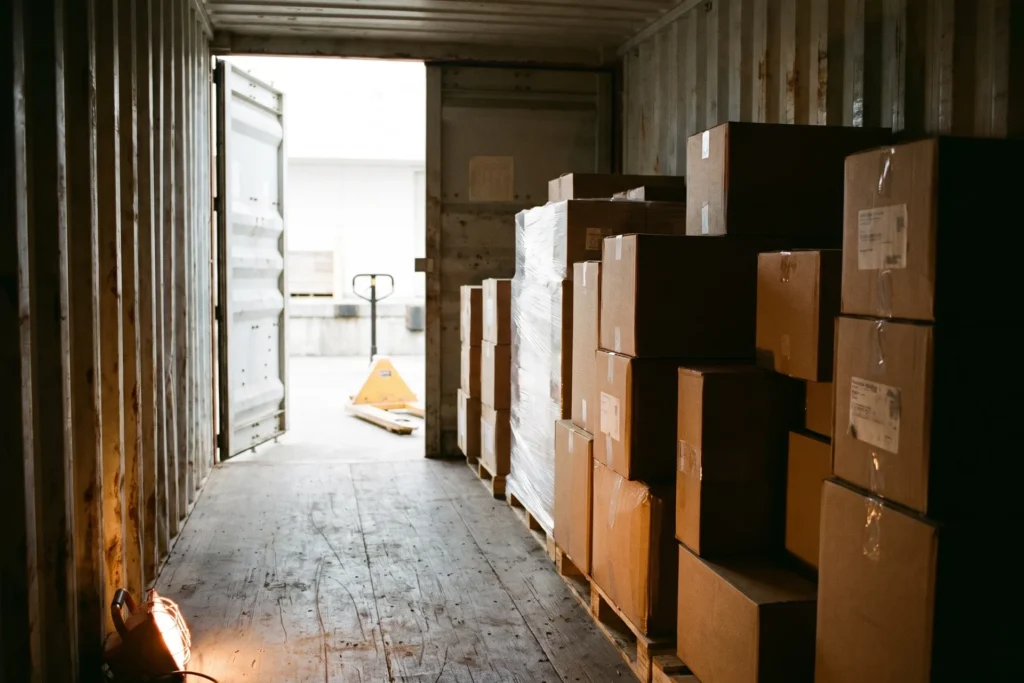

You don’t notice empty space in a container until you start paying for it. It shows up in higher freight costs per unit, in split shipments and rushed air freight, and in stock that arrives too early or too late.
Container utilization optimization means planning each shipment so the container’s volume and payload are used as fully as possible, without breaking weight, stacking or safety limits. It starts before loading, when you decide what to order, from which supplier and when.
What Container Utilization Optimization Really Means
Container utilization optimization turns purchase plans into shipments that respect physical limits (cube, payload, stability) while protecting availability. It combines loading choices with planning choices: service levels, coverage targets and how often you order from each supplier.
Container load optimization vs. container utilization optimization
Container load optimization asks: can this fit?
Container utilization optimization asks: should this ship now, and with what?
The first is a packing problem solved at the warehouse. The second is a planning problem solved earlier, when you set order quantities from replenishment and decide what can wait for the next container.
The two constraints: volume (CBM) and payload
Every container is limited by volume, measured in cubic meters (CBM), and by weight, the maximum payload. Light, bulky goods fill the space first (they “cube out”); dense goods reach the weight limit first (they “weigh out”). Plan only for space and you hit the weight limit; stay under the weight limit and you may ship air.
How to Calculate Container Utilization
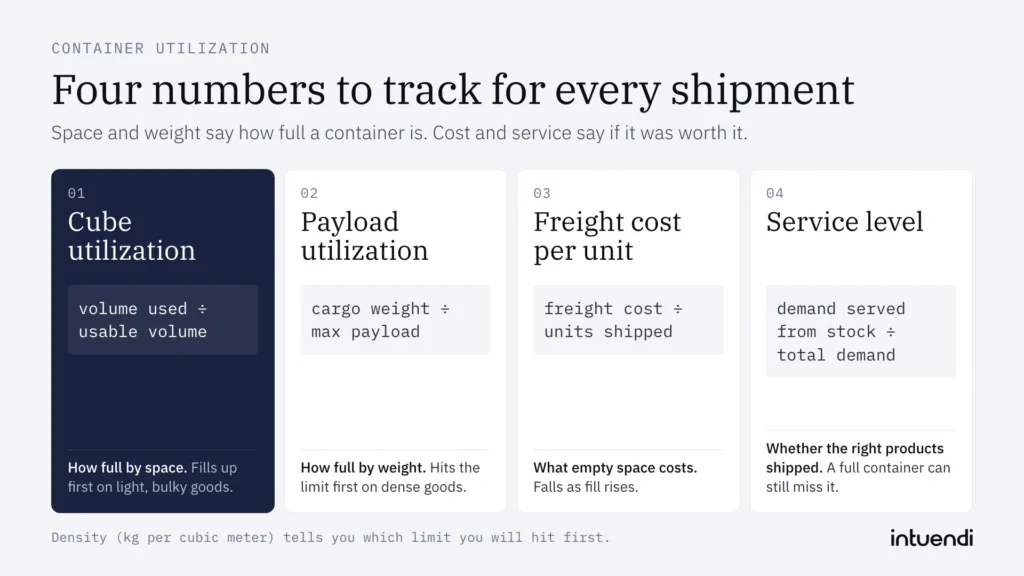
Container utilization is measured on both limits, and the lower of the two is the one to improve:
- Cube utilization % = volume loaded (CBM) ÷ usable volume of the container (CBM) × 100
- Payload utilization % = cargo weight ÷ maximum payload × 100
- Density = cargo weight ÷ volume (kg per CBM), which tells you which limit you will hit first
For example, a 40-foot container has about 67 CBM of internal volume, but cartons and pallets never fill every corner, so planners usually count on a lower usable volume. If the usable volume is 58 CBM and the shipment takes 52 CBM, cube utilization is 52 ÷ 58 × 100 = 90%. If the same cargo weighs 9,000 kg against a payload of about 26,000 kg, payload utilization is around 35%: this shipment cubes out long before it weighs out. Check the exact volume and payload of each container type with your carrier.
To compare shipments, track these numbers together with freight cost per unit and the service level you reached.
Why Containers End Up Underutilized
A part-empty container is usually the symptom of a decision taken earlier:
- Order quantities that ignore the container. The plan is right SKU by SKU, but nobody checks how the order fills the space. MOQ constraints, shifting lead times and split shipments to avoid stockouts do the rest.
- Bad master data. If product dimensions or weights are wrong, every utilization calculation built on them is wrong too. A red flag: planned and actual utilization keep differing on the same suppliers or lanes.
- Mixed SKUs and low stackability. Different packaging, fragile items and awkward shapes leave gaps that no algorithm can close if the stacking rules are not recorded.
Checks Beyond the Fill Rate
Weight distribution and stacking constraints
A container can look full and still be badly loaded. Heavy cartons near the doors or on weak packaging increase damage and loading time. Record stacking limits explicitly: maximum stack height, crush limits, “do not top-load” and pallet overhang, or the plan will work on paper and fail at the dock.
VGM, container tare and gross weight
VGM (Verified Gross Mass) is mandatory in ocean freight. If tare and gross weight assumptions are wrong, you risk delays, penalties and last-minute rework, so check them before booking, not at the terminal.
Strategies to Improve Container Utilization
Better packing helps, but the larger gains come from the decisions that create each container:
- align order quantities with real demand by SKU, using forecast accuracy to decide what deserves space;
- decide what must ship now to avoid a stockout and what can wait for a fuller container;
- give best-sellers priority over slow movers when space is short;
- reduce split orders and partial loads by consolidating purchases from the same supplier.
Top up a part-full container with other products
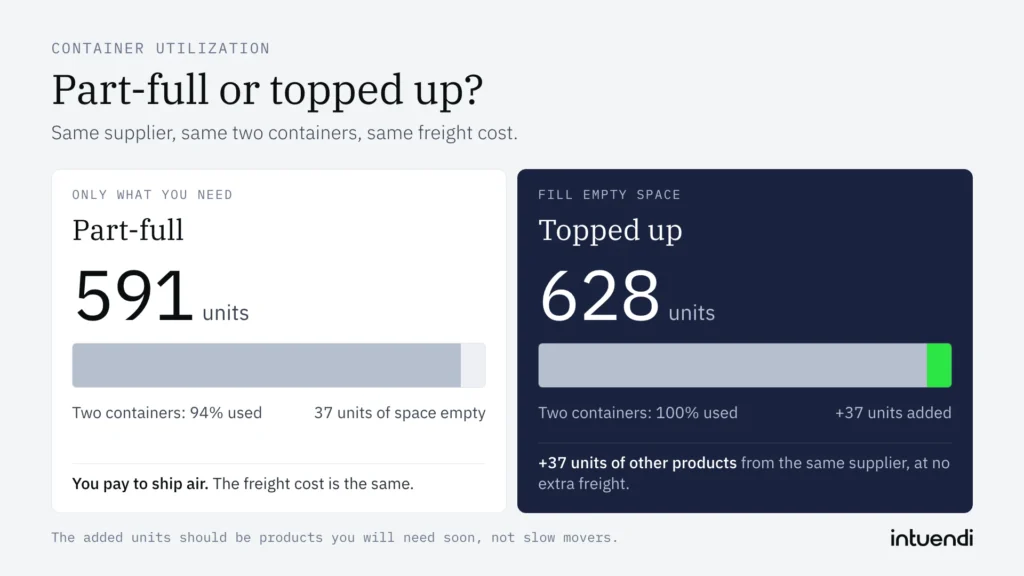
Sometimes the order is right and the container still isn’t full. Say you need 591 units from one supplier, and the two containers you are paying for hold 628. Ship only what you need and the space for 37 units travels empty, for the same freight cost.
The fix is to top up the container with other products from the same supplier, products you would order soon anyway. You bring forward part of the next order instead of shipping air. Choose items with steady demand, not slow movers, or the freight you save turns into excess stock.
In Intuendi this happens inside the purchase order, in the purchase order management software. The Container Optimization panel shows how full each container is by volume and by weight. With the option Fill empty space with other products, the optimizer can add products from the same supplier, and it shows the current and the optimized solution side by side, with every product it added, before you apply anything. Container optimization is an advanced feature, and it works on orders with one supplier and one location.
Not sure where to start? Here is how Symphonie, the AI assistant inside Intuendi, explains it:
The same steps work after any manual change to an order: run the optimization again, compare the two solutions and apply only if the new one is better.
Results with an optimization engine
Intuendi’s optimization engine, M.i.l.o., plans the load on both volume and weight. In a simulated scenario of 110 parcels, it reduced container usage by 33%, from 30 containers to 20, while keeping container utilization above 90%.
Casa de las Baterías, an Intuendi client managing nearly $1M in monthly purchase orders, used demand forecasting to align purchasing and loading with real demand and fill containers more consistently. Read the case study.
Fuller Containers Start at the Purchase Order
Container utilization improves when load building stops being a last-minute task at the warehouse and becomes part of the purchase plan. Measure cube and payload utilization on every shipment, fix the master data behind them, and decide at the order stage what ships now, what waits and what can fill the empty space.
Container utilization optimization refers to the process of maximizing the efficient use of containers during shipping and storage. It is crucial for businesses as it reduces shipping costs, minimizes waste, and enhances overall supply chain efficiency. Companies that effectively optimize container utilization can significantly improve their bottom line.
You can explore a detailed case study that illustrates the benefits of container utilization optimization at the following page. This case study demonstrates how businesses have achieved significant improvements through effective container utilization strategies.
Absolutely. The principles of container utilization optimization apply to businesses of all sizes. Small businesses can leverage similar techniques as those in the case study, such as optimizing product assortment and utilizing technology, to enhance their shipping and storage efficiency.
