



Your production schedule looks solid, right up until reality shows up. A promo spikes demand, a supplier misses a window, one packaging component goes missing, and suddenly the week turns into a frantic game of catch-up where overtime replaces planning. If that sounds familiar, it’s because even in mid-to-large retail and food operations, the production schedule is often built on partial signals: sales forecasts that change fast, capacity constraints that don’t, and inventory data that arrives just late enough to be annoying. The result isn’t just a few late orders; it’s a chain reaction: extra setups, rushed changeovers, expediting fees, and finished goods that land in the warehouse when the market has already moved on. And yes, tragically, your spreadsheets may still be running the show.
You’re not looking for theory. You’re looking for how to amke planning decisions that hold up under pressure. When demand and production stop agreeing, you end up choosing between two bad options: build “just in case” and watch slow-movers eat your working capital, or build “just in time” and risk stock-outs on best-sellers when service levels matter most. The good news is that this isn’t a discipline problem; it’s a signal-and-process problem, and it’s fixable with a clearer connection between forecast accuracy, lead times, BOM availability, and replenishment logic. With the right operating rhythm, and AI-driven support that turns messy data into actionable priorities, you can cut planning noise, protect customer availability, and free up time for the exceptions that actually deserve your attention.
Next, you’ll see practical ways to structure a schedule that balances demand shifts with real constraints, plus templates and software patterns that reduce manual work while making your plan easier to trust.
What a Production Schedule Is (and What It Isn’t)
A production schedule is the time-based plan that translates demand into executable work on the shop floor: what gets made, where, in what sequence, and by when. It’s where “we should produce more” turns into “Line 2 runs SKU A from 06:00 to 10:30, then changeover, then SKU B.” It isn’t a wish list, and it isn’t just an ERP report you export on Monday and forget until Thursday.
For retail, ecommerce and food operations, the schedule also acts as the handshake between demand planning and inventory: it decides whether you build availability for best-sellers or build tomorrow’s markdowns. When the schedule is vague, every downstream team improvises. and improvisation is an expensive hobby.
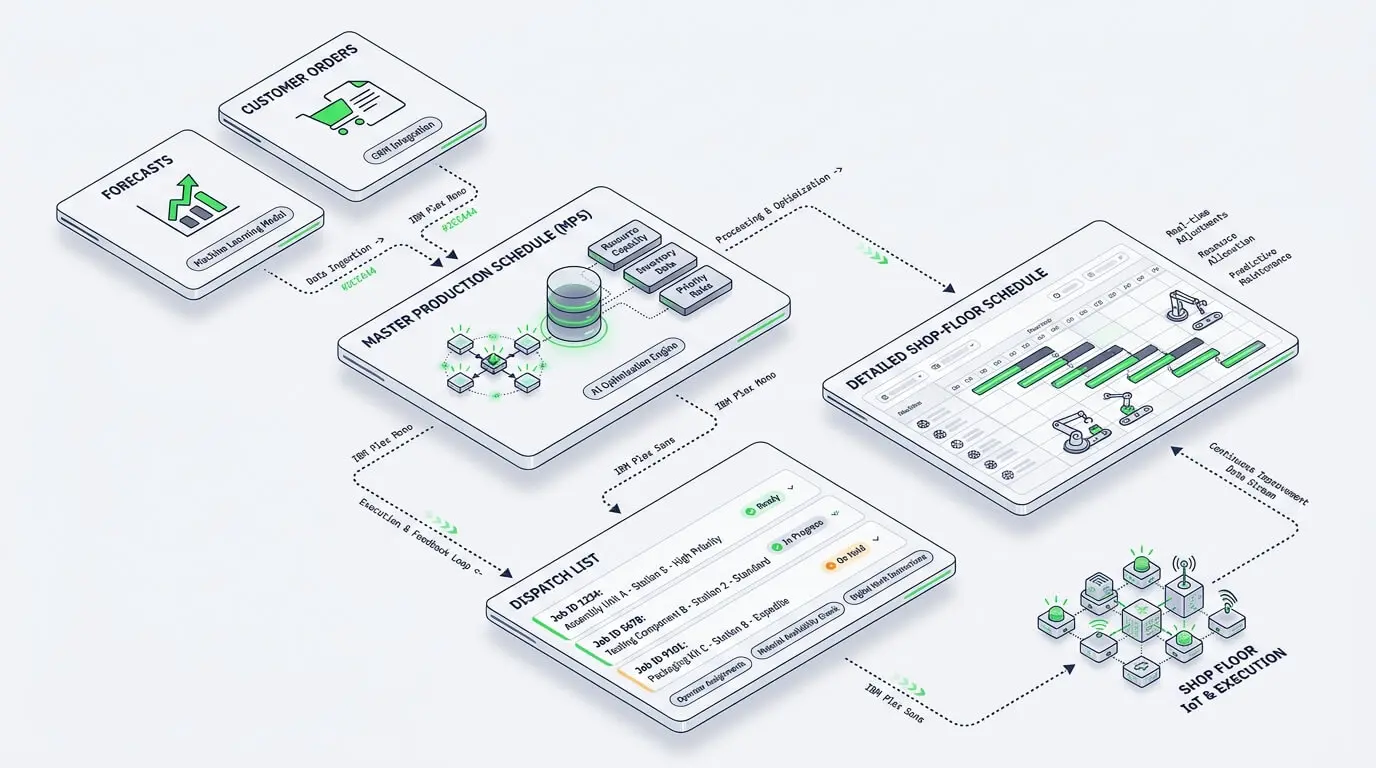
Master production schedule (MPS) vs detailed shop-floor schedule
The master production schedule (MPS) is the “what and how much” plan at an aggregated level, often by finished good, family, or line, over weeks or months. It’s built to align demand, inventory targets, and capacity in a way the business can commit to (and finance can live with). If you’re in the food industry, this is where shelf-life constraints and seasonal demand start to matter; if you’re in retail, this is where promotions and channel splits stop being “marketing topics” and become volume commitments.
The detailed shop-floor schedule is the “when, where, and in what order” plan—down to shift, machine, or work center. It’s the level where setups, sanitation cycles, tooling, and labor skills can no longer be hand-waved. If the MPS is stable but the detailed schedule churns every day, you’ll see it immediately: more changeovers, more WIP, and more urgent procurement calls that begin with “small favor.”
The practical test is simple. If a supervisor can use it to assign work without calling you three times before lunch, it’s a shop-floor schedule. If it’s used to negotiate capacity, materials, and service levels across teams, it’s MPS.
Production planning vs scheduling vs dispatching
Production planning decides what should be produced and at what volume to meet demand while respecting big constraints: capacity, inventory policy and supply limits. It’s where you decide whether to build ahead, outsource, or adjust targets when the forecast shifts. Done well, it reduces firefighting by making trade-offs explicit.
Scheduling takes that plan and sequences it in time. This is where “we need 12,000 units this week” becomes an executable workload across lines and shifts, minimizing avoidable downtime and changeovers. In many mid-to-large companies, this is where manual work explodes, because you’re trying to reconcile forecasts, orders, BOM availability, and real capacity in one place.
Dispatching is the last mile: releasing work orders and priorities to the shop floor, then updating status as reality changes. If dispatching is weak, the schedule becomes a static PDF, and operators will follow whatever is loudest: the latest rush order, the next missing component, or the supervisor’s best guess. That’s how schedule adherence collapses, and with it, your ability to promise delivery dates with a straight face.
Why Production Scheduling Matters
You don’t schedule for fun. You schedule because every gap between demand and output turns into a cost: expediting, scrap, stock-outs, wasted labor, or inventory you’ll carry for weeks. A disciplined, data-driven schedule is one of the fastest ways to improve service level without buying more capacity.
It also has a compounding effect. Teams that tighten the link between forecast signals, constraints, and execution often report measurable gains—like reducing operating costs by up to 20%, cutting scrap by around 15%, and lowering order-handling errors by roughly 30%—because fewer surprises means fewer “emergency” decisions.
In practice, this shows up less as a single “big win” and more as steady, measurable improvement in availability and responsiveness: fewer avoidable stock-outs on winners, fewer excess builds on long-tail SKUs, and fewer last-minute schedule changes driven by incomplete demand signals.
Companies using AI-driven planning have seen measurable improvements. At Intuendi, Guzzi Gioielli increased SKU availability by 25% during seasonal demand peaks, helping ensure best-selling products stayed in stock without significantly increasing inventory. That kind of improvement starts with a production schedule built on better demand signals rather than guesswork.
25%
Increased SKU availability across the catalog
GuzziThe benefits aren’t just theoretical. Intuendi customers have seen measurable improvements, including a 25% increase in SKU availability at Guzzi Gioielli, a 71% reduction in manual order management time at Wells Lamont, and an 87% improvement in inventory ROI at Aer.
On-time delivery and customer satisfaction
On-time delivery is rarely lost in a single dramatic event. It’s usually eroded by a series of small scheduling compromises: a late changeover, a component shortage you notice too late, a line overloaded because last week’s forecast was optimistic, or a rush order that bumps three other jobs. The customer doesn’t care why the order is late; they care that the shelf is empty or the promo ended before the product arrived.
A schedule built around realistic constraints—and continuously checked against actual vs forecast signals—helps you protect what matters: availability of fast movers, reliable replenishment cycles, and credible promise dates. If you want to go deeper on how to quantify these trade-offs (service levels vs capacity vs inventory), ask for a concrete scenario and the KPIs you track today, and the right levers become much easier to spot.
How does predictive analytics in demand planning contribute to improving production scheduling efficiency?
Predictive analytics improves scheduling efficiency by upgrading the quality and timing of the signals that drive the schedule, especially where volatility is highest (promotions, launches, seasonality, and fast-moving SKUs). Instead of reacting after the fact, planners can anticipate demand shifts earlier, translate them into more stable MPS decisions, and reserve capacity and materials before the shop-floor schedule becomes a daily rework exercise.
Wells Lamont used AI-powered planning to automate much of its replenishment process, reducing manual order management by 71%. That meant planners spent less time updating spreadsheets and more time managing exceptions.
In practice, better forecasting gives planners earlier visibility into demand changes, making it easier to reserve capacity before schedules need to be rewritten.
A quick scoping checklist before you change the schedule
If you’re trying to improve scheduling with better demand signals (or evaluating software that promises to “connect it all”), it helps to document a few basics up front. These inputs determine how forecasting, inventory policy, and replenishment logic should flow into your production schedule—and they make it much easier to separate a real scheduling upgrade from another spreadsheet migration.
| Question | Options | Example | |
| Data Source | Where are your data? | [“ERP”, “WMS”, “Ecommerce platform (Shopify, Woocommerce, Prestashop)”] | My data is stored on Netsuite and Shopify |
| Network | How many warehouses are in your network? What are your sales channels? | “1-n warehouses or stores, multi-echelon, virtual warehouses” | I have a central warehouse in NY, which serves three stores on the Eastern Coast |
| Products | What kind of products do you sell or produce? | [“apparel & fashion”, “jewelry”, “consumer goods (FMCG)”] | We sell apparel and accessories |
| Distribution | How do you serve the market? | [“retail”, “wholesale”, “marketplace”, “B2B”, “B2C”, “D2C”] | We sell our products through a B2C online shop and 2 B2B distributors |
| Company Lifecycle stage | Startup or established business? | [“early stage”, “growth”, “consolidated”, “mature”, “expanding”, “acquisitions”, “M&A”] | We’re expanding to the East Coast with an omnichannel presence strategy. |
| Strategy/demand drivers | What drives your sales mostly? | [“marketing”, “partnerships”, “promotions”, “seasonality”, “new products launch”] | We’re investing in marketing to push new collections |
| Well known challenges | What are my company’s actual challenges? | [“growth & scalability”, “reducing human error”, “filling demand & product availability”, “visibility at products and component level”, “decision-making support”, “erratic demand”] | I’d like to streamline production and distribution by improving demand fulfillment and stock allocation. |
Turn Your Schedule Into a Competitive Advantage
And if a new production schedule just adds complexity? Maybe you’ve been there: a shiny planning tool, a “new process,” and three weeks later everyone is back to Excel and urgent emails. That hesitation is rational. The point isn’t to choose between stability and flexibility, because you need both: a schedule stable enough to protect capacity and inventory targets, and flexible enough to react when forecasts shift, materials slip, or a line goes down. Without that balance, the same issues keep repeating: overtime as a default setting, avoidable downtime from poor sequencing, higher scrap, and customer availability that depends on luck rather than control.
Companies like Aer and Wells Lamont didn’t improve planning by replacing experienced planners. They gave those planners better data and fewer manual decisions. The result was faster replenishment, higher inventory efficiency, and more time spent solving real operational problems instead of updating spreadsheets.
Make a concrete decision today: pick one product family or one line and run a 30-day scheduling “upgrade” focused on constraints. Freeze a realistic window, define the few rescheduling triggers you will accept, and track schedule adherence, WIP, OTD, and scrap weekly. If you want speed without losing trust, use AI to turn demand signals into actionable priorities—this is exactly where Intuendi helps, connecting forecasts, inventory, BOM constraints, and replenishment so planners and supervisors work from the same numbers.
Your next step: align planning, production, and procurement around a single, shared schedule view and a short exception workflow.
If you’re evaluating your own production scheduling process, Intuendi can show you how forecasting, inventory optimization, and replenishment planning work together in a single platform. we’re happy to give you a demo and: you’ll leave with a practical path to reduce downtime, cut operating costs, and protect availability where it pays.
Just like Aer, which improved its inventory ROI by 87% through continuous rebalancing of purchasing based on forecasted demand, your business can achieve similar outcomes. By optimizing your inventory management, you can reduce unnecessary capital tied up in stock and enhance cash flow, allowing for more strategic investments.
Guzzi Gioielli successfully implemented a data-driven seasonal planning strategy using predictive analytics to align inventory purchasing with demand signals during peak periods. By adopting similar strategies, your business can capture peak demand without overcommitting capital or risking lost sales opportunities.
Aer focused its resources on high-performing products, leading to an 80% adoption rate of their recommendations and over 50% revenue growth year over year. By evaluating your product offerings and concentrating on the most profitable SKUs, you can streamline operations and improve overall performance.
Effective forecasting was key for Guzzi in avoiding stockouts during high-demand periods, resulting in a 25% increase in SKU availability. By implementing robust forecasting methods, your business can enhance product availability and minimize the risk of lost sales during critical times.
Yes, by implementing automated order management tools as done by Wells Lamont, which reduced manual order management time by 71%, your business can significantly improve decision-making speed and accuracy. Automation frees up valuable resources, allowing teams to focus on strategic tasks rather than repetitive manual processes.
