



Nobody blames the algorithm when a forecast misses a promo peak. They blame the planner who “should have known.” That’s the tension at the heart of every human-in-the-loop supply chain conversation happening right now: you’re expected to outrun the market with data fragmented across your ERP, your e-commerce platform, your WMS, and one too many spreadsheets. Lead times keep stretching. Demand shifts by channel, sometimes by the hour. And every stockout stops being an inventory problem and results in a trust problem with your customer.
You don’t need a robot running your supply chain. You need a better way to make smarter, more confident decisions under pressure (hint hint: Symphonie), and with a partner that does the heavy lifting so you can do the strategizing and deciding (hint hint: Intuendi).
That’s what a human-in-the-loop supply chain actually is, when it’s built right. It keeps human judgment exactly where it belongs, on the exceptions, trade-offs, and context, and hands AI the work it was built for: pattern detection, continuous recalculation, scenario testing, and the relentless job of holding forecast accountable to reality.
When your team is stuck maintaining spreadsheets and chasing alignment instead of making decisions, everything slowa down and inventory mistakes compound. Pair that same team with Symphonie, Intuendi’s in-app AI Intelligence layer that turns your supply chain data into decisions, and the whole equation changes: cleaner signals, faster reactions, fewer expensive surprises.
This is the philosophy Intuendi is built on. Not automation for its own sake, and not a black box you’re asked to trust blindly, just a system that clears the repetitive work off your plate so you can spend your time and energy where it actually moves the needle: service level, coverage targets, multi-warehouse constraints, and the priorities that shift under you every week.
What Human-in-the-Loop Means for Supply Chain AI
If you’re evaluating a human-in-the-loop supply chain approach, the real question isn’t “how much should we automate.” It’s “where does human judgment belong, so automation speeds up good decisions instead of scaling bad ones.”
That’s not a philosophical debate. It’s a Monday-morning problem, the kind that shows up the instant a supplier slips and two channels spike at once.
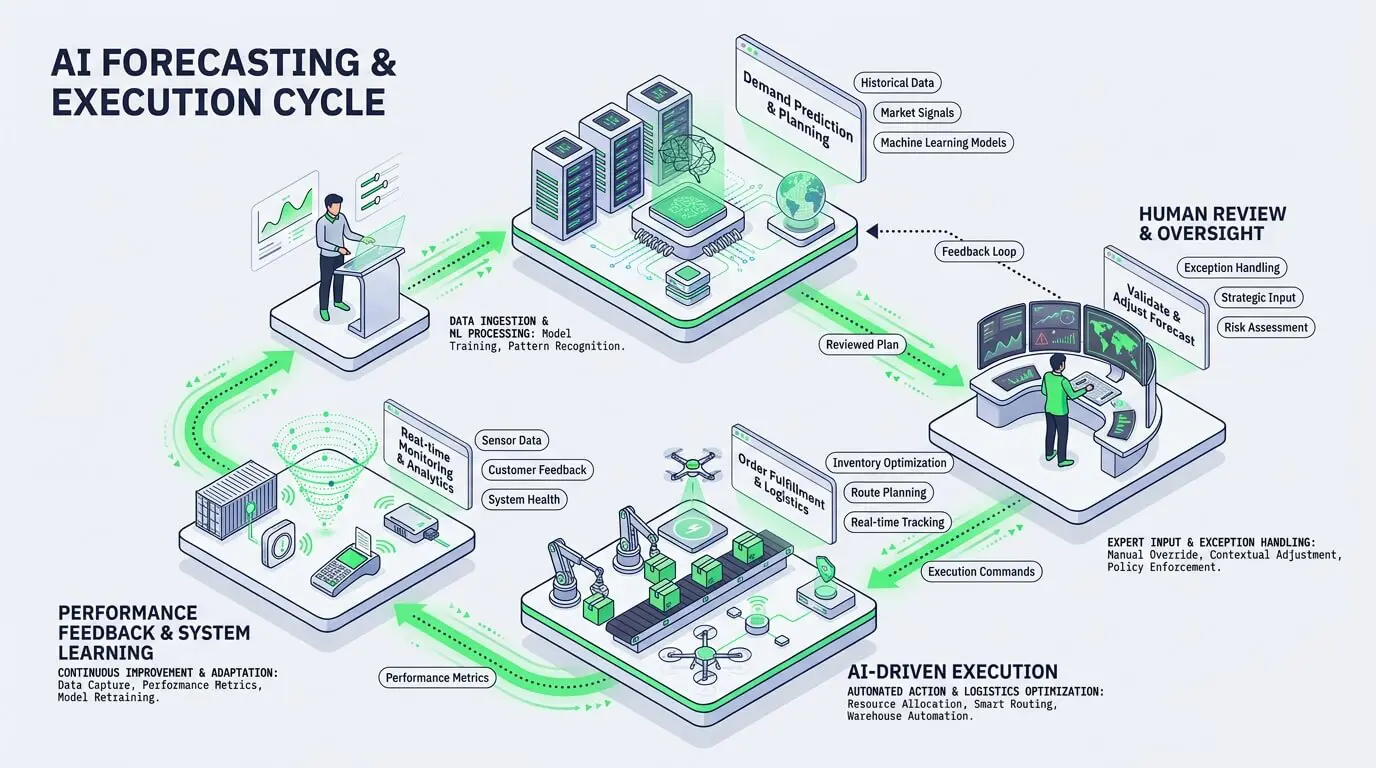
Where automation ends and judgment begins
Automation should own the repetitive math: SKU- and channel-level forecasting, safety stock recalculation, replenishment proposals, and re-running scenarios the moment demand shifts. Your team should own the decisions that require actual business context, whether to lean into a promo even with margin pressure, how to protect your best-sellers without drowning the warehouse in slow-movers, or when a controlled backorder is the smarter play for protecting cash.
Here’s the tell: watch where the hours go. If planners are still babysitting spreadsheets, cleaning data by hand, and rebuilding the same filters every single day, the “AI” bolted onto your process is decoration, not infrastructure. In a human-in-the-loop supply chain that’s actually working, exceptions are the only thing that requires a human. Everything else runs on automation with clear guardrails: service level targets, lead times, pack sizes, MOQs, container constraints.
The loop: detect, decide, act, learn
A human-in-the-loop supply chain works only if the loop is explicit. First, the system must detect what changed (demand anomaly, forecast drift, supplier delay, inventory imbalance across warehouses). Then it must frame a decision, not provide twelve charts and a shrug, but a plain-language read on what’s happening and what to do about it.
This is the step where Symphonie, Intuendi’s AI decision layer, does its job: instead of leaving you to interpret a dashboard, it turns the underlying data into an insight such as “these SKUs risk stockout in nine days; here are the three highest-ROI actions.”
Next: act. Adjust the order, rebalance stock across nodes, update a replenishment policy with approval steps and an audit trail baked in, not bolted on.
Finally: learn. Did the action prevent the stockout, or did it just trade one problem for another? That outcome feeds straight back into the forecasting logic. This is where the payoff shows up. Our customers running AI-driven planning with a real loop in place report gains like a 15% sales lift from sharper forecast accuracy and a 25% reduction in excess stock, simply because inventory policy stops lagging behind reality.
We’ve watched this play out with real teams, not just in theory. La Casa de las Baterias, a battery and energy systems distributor running nearly 1,000 SKUs across four countries, was buried under supplier lead times of two to six months and container-scale minimum order quantities. Buyers were burning dozens of hours per month building spreadsheets with hundreds of formulas just to figure out next month’s purchase order. And they werestill getting it wrong often enough to hurt.
Once the loop had structure with Intuendi:AI handling forecasting, real-time understock/overstock detection, and container-aware purchase order recommendations, the procurement team kept the final decision. Ultimately, La Casa de las Baterias saw stockouts drop 25%, and the business kept growing without inflating total inventory value to do it.
Three misconceptions that quietly derail adoption
“Human-in-the-loop means humans approve everything.” That’s not oversight, that’s alert fatigue. And it ends in decision paralysis, which is worse than no AI at all.
“The model’s good, so let it run.” That’s how you get a perfectly optimized mistake: an order that looks flawless on paper but ignores the supplier who’s been late three times this quarter, or the merchandising shift that hasn’t hit the historical data yet.
“The loop is just a UI feature.” It isn’t. It’s a process design problem — thresholds, roles, escalation paths, and a shared definition of what actually counts as a “case” worth a human’s time. This is where a platform earns its keep: turning noisy signals into replenishment recommendations, and making actual-vs-forecast a daily habit instead of a quarterly autopsy.
“The loop only works inside our platform.” Increasingly, it doesn’t have to. With Intuendi’s MCP Connect, planners can pull replenishment recommendations, check coverage, or ask ‘why is this SKU flagged’ directly from Claude, ChatGPT, or any MCP-compatible AI chatbot. The loop follows the planner instead of forcing them into another tab.
Where Humans Add the Most Value in a Human-Centered Supply Chain
The goal was never to keep your team busy. It’s to keep them decisive. In a human-in-the-loop supply chain, people earn their value exactly where trade-offs get real, data is incomplete, and getting it wrong is expensive. Think: lost availability, capital trapped in the wrong SKUs, or a rush shipment you didn’t budget for.
Demand planning and scenario trade-offs
Forecasting was never the hard part. The hard part is deciding what to do when three different forecasts are all equally plausible. This is where humans are genuinely stronger: weighing whether to protect service level on best-sellers through a campaign or throttle inventory in a high-return category, whether to prioritize one channel strategically or spread allocation to cut cancellations everywhere.
This is where human-in-the-loop stops being a buzzword and becomes an execution advantage. Give planners fast “what if” scenarios (baseline, promo uplift, supply-constrained) and let them approve the right one against real constraints. Watch churn drop fast. Teams running standardized, AI-supported workflows typically cut ordering errors by up to 40%, and near-real-time signals can shrink effective replenishment cycles by around 30% compared to weekly planning energencies.
Loop Earplugs is a great example of what this looks like at speed. With under 300 SKUs spread across 63 sales channels, each with its own launch calendar, pricing, and cannibalization pattern, traditional forecasting couldn’t keep up. Even a lean catalog gets complicated fast when marketing intent, not just history, is driving demand. By building marketing investment signals directly into the forecasting model, the Loop Earplugs team pushed forecast accuracy to 81% and cut forecast error by roughly 50%.
As Tiemen Serroen, Loop’s Supply Chain Manager, put it, the partnership helped the team build “a more structured and consistent planning cycle” that finally matched how demand actually gets created in a fast-moving, marketing-led business.
Human Oversight in Supply Chain Processes During Execution
Execution is where the plan meets reality: suppliers miss dates, carriers move ETAs, and a single best-seller can drain stock across an entire multi-warehouse network overnight. In this phase, oversight isn’t a manual backup plan, it’s the control layer that protects service level the second conditions shift. With AI continuously recalculating lead times, target coverage, and replenishment suggestions in the background, your team gets to focus on the decisions that actually move the needle: what to expedite, what to delay, where to reallocate.
A human-in-the-loop setup that works during execution typically looks like this:
- Reviewing alerts on exceptions (late inbound, sudden demand spikes, supplier constraints) with clear “why” and suggested actions
- Approving or adjusting replenishment proposals when they change working capital, MOQs, or safety stock policies
- Validating substitutions and constraints for Bill of Materials items to prevent production stops
- Coordinating reallocation in multi-echelon networks to protect priority channels and customers
- Tracking actual vs forecast to confirm whether the issue is demand, supply, or data—and act accordingly
This is where Symphonie shines: surfacing the insight and the “why” behind the alert in plain language, so the review of the exception review takes seconds instead of a spreadsheet deep-dive.”
Oversight built this way needs structure, not another recurring meeting. Alerts should be tied to measurable thresholds (coverage, service level risk, lead time variance) with every change traceable back to a decision. The payoff is operational control without extra manual overhead: faster decisions, fewer fire drills, and better availability where it matters most, in front of the customer.
Human-in-the-Loop vs Human-on-the-Loop vs Human-out-of-the-Loop
These three models describe where human judgment sits relative to automation, and that placement directly shapes your service level, your working capital, and how fast you can actually move.
Human-in-the-Loop (HITL) means your team actively reviews, adjusts, and approves AI outputs, especially anywhere stock-out risk, overstock exposure, or coverage targets are on the line.
Human-on-the-Loop (HOTL) shifts people into a supervisory role: the system runs most decisions on its own, and planners step in when KPIs start to drift.
Human-out-of-the-Loop (HOOTL) removes people from day-to-day decisions entirely. Efficient in stable conditions, risky the moment lead times shift, BOM constraints appear, or demand turns by channel without warning.
Fit comes down to volatility, data quality, and how expensive it is when you’re wrong. In multi-warehouse or multi-echelon networks, HITL usually delivers the fastest time-to-value, because it builds trust as you go: your team validates recommendations against real constraints while the model gets smarter from the feedback. HOTL becomes the right call once your thresholds, roles, and exception handling have matured into something you actually trust. HOOTL stays limited to narrow, predictable, low-risk flows. Think stable-demand, short-lead-time items with guardrails already built in.
- Human-in-the-Loop: best for high-impact SKUs, new product launches, promo periods, and messy master data—AI proposes, humans decide.
- Human-on-the-Loop: best for scaled replenishment where planners manage by exception—AI executes within agreed policies.
- Human-out-of-the-Loop: best for constrained, predictable flows—automation runs with minimal oversight, with periodic audits.
- A common path: start with HITL to prove ROI and reduce manual work, evolve to HOTL as confidence and data discipline grow.
Most teams find their way here the same way: start with HITL to prove the ROI and take the manual work off the table, then graduate to HOTL as confidence and data discipline build up. For us, “full automation at any cost” was never the goal. Decision velocity with control is the goal. Which means that with the AI-powered suggestions from Symphonie that expose the numbers and the logic behind them (actual vs. forecast, the drivers, the coverage), a team spends the majority of its time on the handful of decisions that actually move inventory and customer availability.
Data, Feedback, and Continuous Learning at Scale
At scale, supply chain performance is a data problem before it’s a planning problem. If your ERP, WMS, and e-commerce data don’t reconcile, your forecast accuracy and replenishment logic will drift, especially in multi-warehouse/multi-echelon networks where lead times and service levels vary by node.
Our approach stays pragmatic: standardize the inputs, monitor quality continuously, and keep a clean, traceable line from signal to decision.
Real improvement comes from tight feedback loops, not the occasional model tune-up. Your planners need an always-on view of actual vs. forecast to spot bias early, understand promo effects, and separate genuine best-seller momentum from noise. Every exception you resolve — a late supplier delivery, an unexpected spike, a channel shift — becomes structured learning that makes the next cycle sharper.
Guzzi Gioielli, a luxury jewelry retailer growing revenue 140% over two years, ran into exactly this kind of feedback problem. Big, infrequent purchase orders had kept the shelves stocked, but they were creating serious cash flow volatility: heavy capital commitments concentrated into a few brutal months a year.
By shifting to smaller, more frequent orders guided by continuous demand signal rather than gut instinct and habit, Guzzi Gioielli cut peak purchasing levels by 36.4%, reduced total purchase order value by 19.4%, and brought monthly purchasing volatility down from nearly 12x variation to just 4x. That’s not just a tidier spreadsheet. It’s a business that can scale without its own cash flow working against it.
To make your own feedback loop actionable, a few controls do most of the work:
- Track data freshness and completeness across ERP/API feeds to avoid planning on stale numbers
- Review forecast accuracy by SKU/channel and segment (best-seller vs slow-mover) to prioritize effort
- Monitor service level, target coverage, and lead time variability to calibrate replenishment policies
- Use exception dashboards to validate recommendations and capture planner adjustments as learning signals
Over time, this operating system compounds. You move from “fixing the plan” to improving the process: fewer spreadsheet handoffs, clearer accountability, and decisions that withstand volatility because they’re grounded in measured outcomes.
Human-in-the-Loop Supply Chain: Make It Real, Measurable, and Worth the Effort
If you’re hesitating, that’s not a lack of vision, that’s pattern recognition. You’ve sat through AI pitches that promised “accuracy” and delivered a dashboard nobody trusted. A human-in-the-loop supply chain can absolutely fail if the loop stays vague, if data quality gets ignored, or if your team has to approve every single suggestion until they stop looking at any of them. The good news: none of those failure modes are a mystery. They’re design choices, and you get to make different ones.
A well-built human-in-the-loop supply chain doesn’t erode accountability, it sharpens it. Decisions become traceable, exceptions become explicit, and actual vs. forecast is visible early, well before inventory turns into empty shelves or dead capital sitting in a warehouse.
So here’s the move: pick one narrow, high-impact scope and prove the value fast. Start with a single business-critical slice: your top SKUs, one warehouse, one channel, or a promo-heavy category. Then, define upfront what your team controls (service level, target coverage, supplier constraints) versus what AI should own (forecast refresh, replenishment proposals, exception detection). And finally, measure it with a simple scoreboard: forecast accuracy movement, stockout rate on best-sellers, excess stock on slow-movers, and planner hours reclaimed from manual work.
How Intuendi Puts This Into Practice
The loop only works if it’s easy to stay inside it, and two things make that possible when working with us:
Symphonie: Your AI-Assistant and decision layer, embedded directly in your Intuendi dashboard. It turns the numbers you already have (forecast, coverage, replenishment risk) into plain-language insights and recommendations. Reviewing an exception takes seconds, instead of a spreadsheet or dashboard deep-dive.
MCP Connect: The access layer for Intuendi’s Intelligence. It brings that same intelligence into the AI assistant your team already has open, whether that’s Claude, ChatGPT, or any other MCP-compatible AI chatbot. Planners can now ask Claude “why is this SKU flagged?” or Finance can now ask ChatGPT “what is the current inventory value” without having to switch tabs or learn a new dashboard, respectively.
Together, these are what keep a human-in-the-loop supply chain from becoming another tool people have to remember to check.
Ready to see what that looks like for your business? Book a demo with Intuendi.
