


Guesswork used to be the cost of doing business in supply chain planning. Not anymore.
AI-powered demand forecasting doesn’t just predict what customers will buy next, it gives supply chain and inventory teams a strategic edge: fewer stockouts, less dead stock, and more capital freed up to reinvest in growth. Think of it less as a reporting tool and more as a co-pilot, one that’s constantly reading the market so your team doesn’t have to guess.
What AI actually changes about demand forecasting
At its core, AI demand forecasting uses machine learning and, for more complex cases, neural networks to turn raw sales history into forecasts that adjust as your market does.
Where traditional forecasting methods lean on fixed formulas and last year’s numbers, AI-driven demand forecasting looks at the fuller picture: seasonality, promotions, weather, economic shifts, even social trends. It weighs all of it, learns from every transaction, and keeps refining itself. The result isn’t a static forecast you build once a quarter, it’s a living one that gets sharper with every order.
That matters more than it might sound. Supply chains that plan reactively pay for it twice: once in tied-up capital from overstock, and once in lost trust when a best-seller runs out. Neither is cheap. AI demand forecasting is what lets a team get ahead of both, spotting demand shifts before they turn into a problem on the warehouse floor.
Take our client, Aer-Wsale, a Croatian wholesaler and dropshipper of e-cigarettes and liquids. Growth had tied up capital in slow-moving SKUs while best-sellers kept running out. A familiar tension for any high-SKU business. Once Aer-Wsale started using Intuendi to identify slow movers and reallocate capital toward high-rotation, high-profit SKUs, inventory ROI improved by 87%, with cash efficiency strengthening without any tradeoff on service levels.
Where AI outperforms the old playbook
Time series analysis, done at scale. Machine learning models scan years of historical data to catch seasonal rhythms and market shifts human planners would need days to find manually, then turn those patterns into replenishment schedules that actually hold up.
Complexity, handled. Comparing AI vs Excel in demand forecasting, it’s evident that AI’s data-driven approach outpaces traditional methods by integrating broader variables and real-time data for more precise predictions. In categories like fashion or electronics, where trends move fast and don’t repeat, deep learning models pull signal from far more variables than a spreadsheet ever could.
Problems caught before they become expensive. Real-time anomaly detection flags the unusual spike or the unexplained drop the moment it happens, so your team can respond to a disruption instead of discovering it after the fact.
The need for demand forecasting in modern supply chains
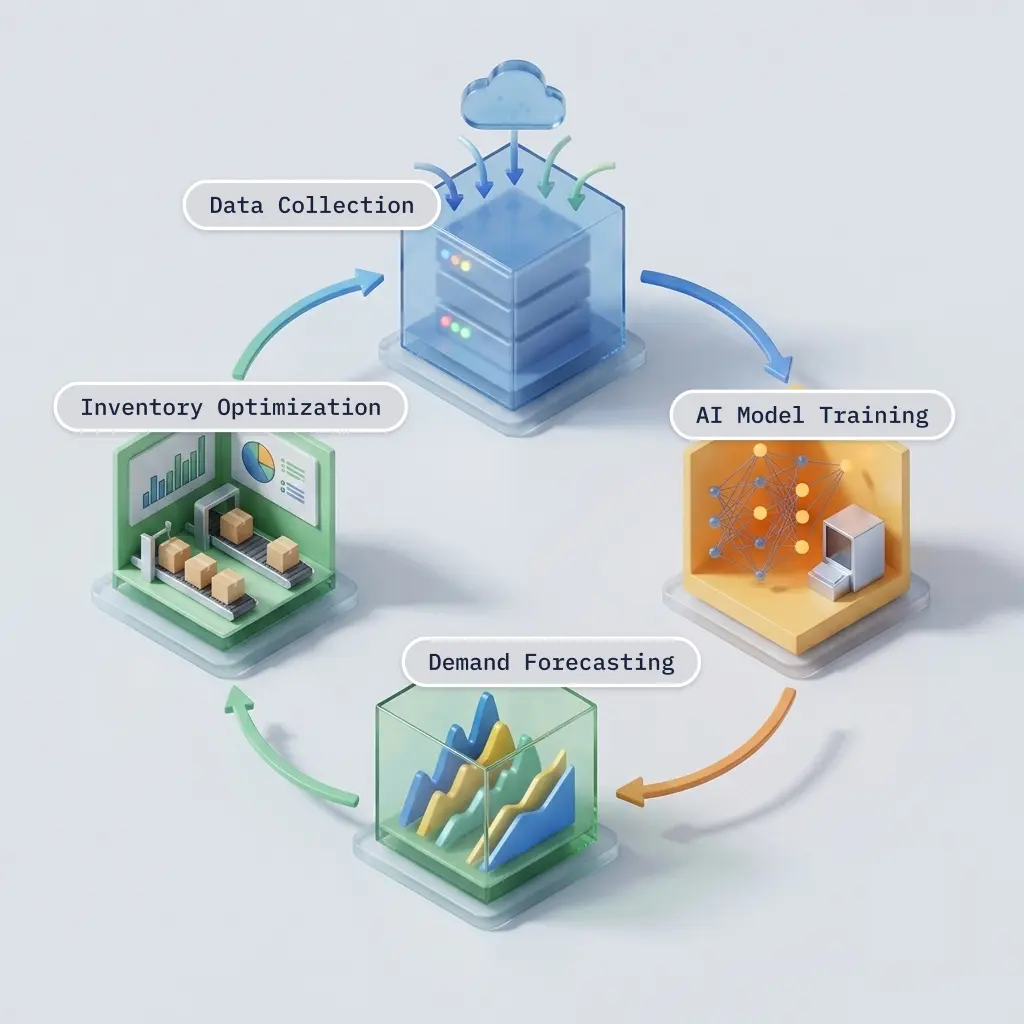
The starting point is always your data: ERP, sales history, inventory positions, and outside signals like promotions or seasonality. Intuendi connects to all of it via API, so forecasts stay current without a single manual import.
From there, Symphonie, Intuendi’s in-app agentic AI assistant, becomes the Intelligence layer that turns that data into decisions. Ask it a question in plain language and get a real-time answer, no dashboard-hunting required. It surfaces the recommendation, explains the logic behind it, and with your approval, can even act on it, whether that’s fine-tuning a forecast or adjusting a supplier’s lead time.
And because your team already lives inside ChatGPT, Claude, or another AI assistant day to day, that same intelligence doesn’t have to stay locked inside Intuendi. Through MCP Connect, you can bring Intuendi’s forecasts, inventory data, and purchasing recommendations directly into the AI tools your team already has open. Always synced with your business systems, always just a question away.
Implementing AI-driven strategies anticipates demand shifts and efficiently reduces stock-outs, seamlessly aligning with business objectives and preserving customer satisfaction through advanced inventory management methods.
How AI transforms demand prediction accuracy
In an ever-changing market landscape, accuracy is your best friend. AI doesn’t just predict demand; it revolutionizes how efficiently you can respond to it. Let’s delve into how AI brings unparalleled precision to demand forecasting.
Machine learning algorithms for time series analysis
Machine learning algorithms identify patterns in time series data, analyzing historical data to detect seasonal trends and market shifts. This allows strategic planning of inventory replenishment schedules, minimizing wastage and leveraging sales opportunities.
Deep learning models for complex demand patterns
Deep learning models process vast amounts of data from diverse sources, identifying complex interdependencies. They’re ideal for markets like fashion and electronics, where trends change rapidly and unpredictably.
Automated pattern recognition and anomaly detection
AI excels in real-time pattern recognition and anomaly detection. Detecting unusual spikes or drops allows proactive management of supply chain disruptions, preparing for the future with confidence.
How to use AI for demand forecasting in supply chain operations
Implementing AI-powered demand forecasting starts with connecting data sources, such as ERP, sales history, inventory levels, and external signals like seasonality or promotions. Platforms like Intuendi integrate via API with your systems, ensuring forecasts stay fresh and eliminating manual imports. Additionally, the use of Symphonie, Intuendi’s in-app AI assistant, designed to turn every decision into your competitive advantage after integration with existing infrastructure can enhance the overall forecasting capabilities by providing a versatile data management framework. Furthermore, connect ChatGPT, Claude, Gemini, and other AI assistants to Intuendi through MCP integrations.
Moreover, platforms like Intuendi highlight how technology simplifies demand forecasting by integrating data sources and automating processes, ensuring your forecasts remain current and accurate.
The AI model generates forecast accuracy at SKU and location level, breaking down predictions by channel, warehouse, or segment. You get granular insights showing how best-sellers behave differently from slow-movers. The system continuously learns from actual vs forecast performance, adjusting as conditions shift.
AI suggests what to order, when, and where based on target coverage, lead times, and service level goals. Key steps include:
- Set target coverage aligned with lead time and service level for each SKU category
- Review AI-generated replenishment suggestions daily or weekly, adjusting for constraints or budget caps
- Monitor actual vs forecast dashboards to catch trend shifts early and recalibrate
- Automate routine reorders for stable SKUs, freeing your team for exceptions and launches
- Integrate multi-echelon logic for multiple warehouses or sites, optimizing stock positioning
The payoff is a planning cycle that cuts overstock and stockouts at the same time, while giving your team back the hours they used to spend reconciling spreadsheets.
That’s not an abstraction. Before adopting Intuendi, Wells Lamont was spending around 15 hours a week just on forecasting, plus another 5 to 20 hours on inventory analytics, depending on complexity. After implementing Intuendi’s AI-driven platform, forecasting time dropped to roughly 10 hours a week, analytics standardized at under 6, and order management fell from as much as 10 hours down to just 1–3. That’s time a team gets to redirect toward the decisions that actually move the business forward.
AI demand forecasting tools for different business needs
Not every business needs the same thing from an AI forecasting platform. A high-SKU e-commerce retailer and a manufacturer juggling multi-level Bills of Materials are solving different problems, and the right tool should flex to match.
If you’re a small or mid-sized business, speed to value matters most. Pre-built connectors, a fast API integration, and dashboards your team can actually use without a training manual. That’s the gap Intuendi was built to close: enterprise-grade intelligence, without an enterprise-length implementation.
For larger enterprises and complex supply chains, advanced features are essential:
- Multi-location forecasting with transfer recommendations between warehouses
- BOM explosion and component planning for manufacturers managing assembled products
- External variable integration capturing promotions, events, and market signals
- Actual vs Forecast analytics to refine model performance and spot trend changes
- Customizable service levels and target coverage calibrated to lead times and working capital strategy
The right platform scales as your needs evolve. Start with your biggest pain point, such as stockouts, excess inventory, forecast accuracy, or manual planning hours, and choose a tool that translates complexity into clear, confident decisions.
AI demand forecasting in retail and e-commerce
Few environments test a forecasting engine like retail and e-commerce: thousands of SKUs, multiple channels, seasonal peaks, promo spikes, and customer preferences that shift overnight. AI demand forecasting earns its keep here by reading historical sales, channel behavior, and outside signals together, so buyers move from reactive guesswork to replenishment decisions grounded in what’s actually happening.
We’ve seen this play out with real customers. La Casa de las Baterías, a leading battery and energy systems provider across Central America, was managing nearly 1,000 SKUs across dozens of branches with supplier lead times stretching from two to six months. Spreadsheets couldn’t keep pace. After adopting Intuendi’s AI-powered demand planning, La Casa de las Baterías cut stockouts by 25% and grew ROI by 18%, while carrying 12% less inventory.
As Regional Procurement Manager Juan Raúl Gómez put it: “Many costly mistakes were made before, but now we know exactly what and how much to purchase. Intuendi saves us time and prevents lost sales.”
Seasonal peaks tell a similar story. Guzzi Gioielli, an Italian luxury watch and jewelry maker, used Intuendi’s demand planning analytics to prioritize high-margin inventory and rebuild its retail merchandising strategy around real assortment data. The result: a 17.5% year-over-year revenue increase during peak periods like Black Friday, without destabilizing cash flow to get there. And it’s not just retail-scale players seeing the shift, the same forecasting discipline is what let Aer-Wsale, mentioned earlier, turn 87% of its inventory ROI gains into capital it could reinvest in growth instead of leaving it parked in slow-moving stock.
Key benefits of AI demand forecasting for retail and e-commerce include:
- Optimized stock levels across multiple warehouses, stores, and fulfillment centers, reducing both stock-outs and overstock
- Channel-specific forecasts that account for differences between online, in-store, marketplace, and B2B sales patterns
- Automated replenishment suggestions that save hours of manual analysis and speed up purchasing decisions
- Event and promotion planning with accurate demand predictions for seasonal campaigns, flash sales, and new product launches
- Improved service levels and customer satisfaction through consistent product availability
Platforms like Intuendi integrate directly with retail ERPs and e-commerce systems via API, pulling in order history, inventory positions, and lead times to generate actionable forecasts at SKU and location level. The focus is on time-to-value: clear dashboards, target coverage metrics aligned to your service goals, and reports that make it easy to compare forecast vs actual performance and refine your strategy over time.
Measuring the business impact of AI for demand planning
Bold claims are easy. What matters is what you can measure.
Start with forecast accuracy. Track your MAPE before and after deployment. Then move to inventory health: days of inventory outstanding, stockout frequency, overstock reduction, turnover. La Casa de las Baterías is a good benchmark here: a 25% drop in stockouts and 12% less inventory carried, both tracked and proven, not estimated.
Don’t stop at operations, either. The financial story is often the most compelling one. Reduced carrying costs, fewer obsolescence write-offs, and working capital freed up for reinvestment. Aer-Wsale’s 87% inventory ROI improvement is what that looks like when slow movers stop absorbing cash that could be funding growth instead.
Efficiency gains matter too, even if they’re harder to put a number on at first: hours your team gets back from manual work, and how much faster planners can move once they’re working from actual-vs-forecast data instead of a spreadsheet. Wells Lamont‘s team went from spending up to 20 hours a week on inventory analytics to under 6. That’s the kind of number that gets a CFO’s attention as much as a stockout metric does.
To make impact visible, establish a reporting cadence including:
- Monthly accuracy reviews comparing AI forecasts against actuals by category and location
- Quarterly inventory health reports showing stock-out reduction, overstock trends, and coverage targets
- ROI dashboards tracking carrying cost savings, obsolescence reduction, and working capital improvements
- Time-to-decision metrics measuring how quickly teams generate and act on replenishment recommendations
- Stakeholder feedback sessions with procurement, sales, and finance to align on success criteria
From Data to Decisions: Harnessing AI for Smarter Demand Predictions
AI demand forecasting isn’t a plug-and-play formula, it’s a capability that adapts to how your business actually runs, sharpening the strategy you already have rather than replacing it.
The smartest way in is rarely a full overhaul on day one. Start with a pilot. See the accuracy gains for yourself. And when you’re ready to go further, know that the intelligence doesn’t have to live in one more tab with Symphonie and MCP Connect, it can live wherever your team already works.
