



Your P&L says you’re doing fine, but your bank balance disagrees. If that gap sounds familiar, stop interrogating your sales team and start interrogating your shelves.
The number you’re looking for is Gross Margin Return on Investment (GMROI). It’s not glamorous. It won’t trend on LinkedIn. But it asks the one question every retailer and distributor eventually has to answer:
Is our inventory actually earning its keep, or is it just really good at taking up space?
What is the gross margin return on investment?
GMROI answers: how much gross margin are you generating for every dollar tied up in inventory? Inventory is cash with a barcode. When GMROI is weak, the business can look busy while profitability and liquidity quietly disagree.
For finance and planning teams, GMROI connects operational choices such as coverage, safety stock, and replenishment frequency, to a return-on-capital logic that is easier to defend in budget conversations.
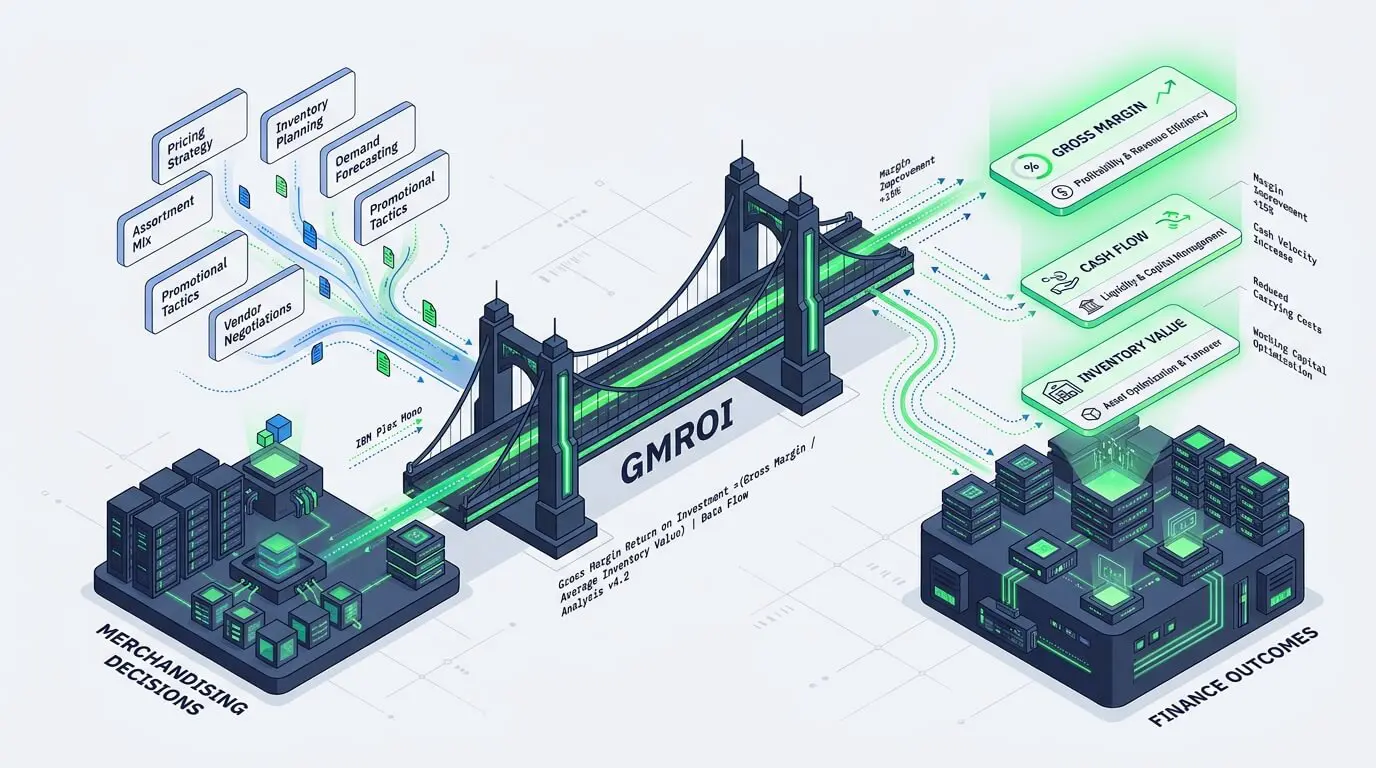
What Gross Margin Return on Investment (GMROI) Really Measures
GMROI is the handshake between finance and ops, the number that finally gets both teams speaking the same language. It measures how much gross margin you’re generating for every unit of currency you’ve got tied up in stock.
GMROI in plain numbers (and why it beats gut feel)
Here’s the plain-numbers version: A product that generates €200,000 in gross margin against €100,000 in average inventory (at cost) gives you a GMROI of 2.0. That’s two euros earned for every one invested. Now take a line that generates €120,000 in margin, but needs €200,000 in stock to support it. GMROI drops to 0.6. It’s selling. It’s just doing so slowly and expensively, with storage costs, markdown risk, and obsolescence quietly eating the difference.
That’s the trick GMROI pulls off: it won’t let margin lie to you in isolation. A high-margin SKU can still be a cash trap if it needs deep buffers to stay available. A fast-turning SKU can look busy while contributing almost nothing once you account for the capital behind it. GMROI makes both of them show their cards.
The formula:
GMROI = Gross Margin (€) / Average Inventory Cost
The part that trips teams up isn’t the gross margin return on investment formula, it’s agreeing on the inputs. Gross margin is net sales minus COGS. Average inventory has to be valued at cost, not retail, because you’re measuring cash exposure, not sticker price. In volatile categories, average weekly or even daily rather than just beginning-and-ending balances, or the number will lie to you by omission.
Gross margin return on investment calculator
A GMROI calculator doesn’t need to be fancy. You need net sales, COGS, gross margin dollars, and average inventory at cost segmented by SKU/category and time period. The hard part is preventing version drift where every team uses a different definition.
For a faster, more consistent starting point, Intuendi provides a dedicated ROI calculator to frame inventory and margin impact with clear assumptions. Once standardized, pressure-test with real examples before using GMROI to steer buying and replenishment decisions.
Why a best-seller can still be a cash trap
“Just in case” inventory is where good intentions go to tie up your working capital. Buffer aggressively to protect availability and you’ll dodge stockouts, but if average inventory balloons to get there, GMROI drops even while the top line looks healthy. The SKU is popular. The dashboard is green. The cash is somewhere else.
This is exactly the pattern we saw at Greg’s Motor Spares, a Namibian auto-parts distributor running 31 locations and a catalog of more than 33,000 SKUs. Breadth was the business, but a growing share of capital was quietly parked in slow-moving stock. Using location-level ABC classification and revenue-to-inventory tracking inside Intuendi, the team rebuilt how capital was allocated across the network instead of just trimming the assortment.
Over the following year, Greg’s Motor Spares grew revenue 54%, and the business held steady at roughly €0.50 in revenue for every €1 of inventory, peaking at €0.60. This proved that growth and capital discipline aren’t actually in tension. They just need to be looked at with the right lens.
How GMROI Impacts Financial Performance
GMROI translates inventory decisions into manageable financial outcomes: cash, profitability, and risk. Improve GMROI by raising gross margin through better mix and fewer markdowns, reducing average inventory through smarter replenishment, or both. The result is less friction between operational targets and financial expectations.
The working-capital chain reaction
Inventory is working capital in physical form. Weak GMROI means financing low-quality returns: cash parked in slow movers, tightening credit lines, “availability” competing with “liquidity.” Improving GMROI performance frees capital without cutting service levels, if you act on the right levers.
Understand what drives average inventory up: over-ordering, duplicated safety stock, stale min/max rules, forecast bias, supplier constraints, or replenishment cadence mismatched to demand volatility. GMROI shows where to focus root-cause analysis first.
Connect GMROI to replenishment parameters, like target coverage, reorder points, and lead times, and turn a finance metric into an operational control system. S&OP discussions become less emotional and more useful.
When GMROI in retail is the right KPI and when it is not
GMROI works best when optimizing inventory investment across SKUs, categories, suppliers, or channels, especially when working capital is under scrutiny. It’s effective for comparing items with different price points, demand patterns, and replenishment constraints.
It’s less reliable when inventory is intentionally strategic. New launches, spare parts, service-critical items, or traffic drivers may deserve space even if GMROI is temporarily low. Track GMROI, but interpret it alongside service level targets and the specific role of the SKU.
Where GMROI exposes silent profit leaks
Weak GMROI is almost always the fingerprint of two problems coexisting: overstock and stockouts, feeding each other in a loop. Overstock inflates your average inventory and markdown exposure. Stockouts kill sales, distort your demand signal, and trigger the reactive over-ordering that creates next quarter’s overstock. Nobody plans this. It just accumulates.
GMROI spots where leaks happen by category, channel, and SKU. If GMROI drops while sales stay stable, average inventory is creeping up (coverage too high, wrong lead time assumptions, multi-warehouse imbalance). If GMROI drops while inventory stays flat, margin is eroding (promotions, higher landed costs, mix shift).
Italian luxury retailer Guzzi Gioielli hit a version of this at speed. After 140% revenue growth over two years, the leadership team faced a harder question than “how do we sell more,” but instead “where should the next euro of inventory actually go.” Limited visibility into which brands and categories were driving real returns meant capital risked drifting toward slower movers during exactly the periods it should have been chasing demand.
Using Intuendi’s demand planning analytics to prioritize high-margin categories and align purchasing with real demand patterns, the team turned assortment strategy into a genuinely quantitative exercise. The result: Guzzi saw 17.5% revenue growth and a 12% improvement in profit margin, not from selling more stuff, but from being more deliberate about which stuff.
Then there’s the opposite failure mode: starving growth to protect margin. Tannico, the world’s largest Italian online wine retailer, had to scale its catalog from 10,000 to 15,000 SKUs without letting shipping promises or margins slip. Using Intuendi’s AI demand forecasting to guide SKU-level stock quantities and top-down inventory planning, Tannico grew units in stock 89% year-over-year and lifted product availability from 88% to 94%, while keeping overstock and margin erosion in check. Availability went up. Capital efficiency didn’t go down. That’s the whole GMROI argument in one case study.
Here’s how Intuendi and our AI assistant Symphonie can help map GMROI insights to quick decisions:
- Adjust target coverage where demand is stable but inventory is bloated.
- Revisit safety stock where lead time variability—not average lead time—is the issue.
- Separate best-sellers from slow movers in replenishment logic.
- Use actual vs forecast patterns to identify bias before it becomes expensive inventory.
- Rebalance stock across warehouses before placing new orders.
Turning Gross Margin Return on Investment Into a Decision, Not a Spreadsheet Souvenir
A GMROI number that lives in a quarterly deck and nowhere else is just trivia. The move is to make it operational: pick a category or your top 50 SKUs, lock down one definition for gross margin and average inventory at cost, and run it monthly for 8–12 weeks with a rule attached, act on it (adjust coverage, renegotiate supplier terms, revisit safety stock) or consciously accept the number and document why.
This is exactly where things get more interesting than a spreadsheet can handle. GMROI tells you where the leak is. It doesn’t tell you, at 2am on a Tuesday, whether your lead time assumptions just shifted or whether that “slow mover” is actually a seasonal spike about to hit. That’s the intelligence we built Symphonie for — Intuendi’s agentic AI assistant that sits inside the platform, reads your data in real time, and surfaces the anomalies, trends, and recommendations before you have to go hunting for them. Ask it a question about coverage or margin exposure in plain language, and it answers — with the logic behind the answer laid out, not buried in a black box.
And if your team already lives and works inside ChatGPT, Claude, or another assistant, you don’t even have to open a new tab. Intuendi now connects to any MCP-compatible AI or LLM, giving your models secure, governed access to live forecasts, inventory positions, and procurement recommendations. Always synced, always accurate, never a stale export sitting in someone’s downloads folder. Inventory intelligence, wherever your team is already working.
The Bottom Line
GMROI only works when inventory valuation and margin inputs are consistent. It’s normal to accept lower returns for new launches or strategic traffic drivers while pushing harder elsewhere. The point is to stop funding low-quality inventory returns by accident.
Here’s the concrete move: pick one category (or top 50 SKUs), agree on one definition for gross margin dollars and average inventory at cost, then run GMROI monthly for 8–12 weeks with an “act or accept” rule. Change pricing/markdown discipline, coverage and safety stock, supplier terms, or explicitly accept the outcome and document why. This step is most valuable for finance, supply chain, and planning leaders who need decisions that hold up in the P&L and in the warehouse at the same time.
GMROI won’t fix a broken supply chain by itself. But it will stop your best-sellers from quietly bankrupting your working capital, and it will stop your slow movers from hiding in plain sight behind a healthy-looking margin line. Track it consistently, connect it to real replenishment decisions, and let AI, whether that’s Symphonie inside the platform or your preferred LLM via MCP do the constant watching so you don’t have to.
Your inventory has an opinion about your cash flow. GMROI is just the translator.
Curious what your own GMROI is quietly telling you? Try Intuendi’s ROI calculator or get a demo to see it mapped against your real catalog.
