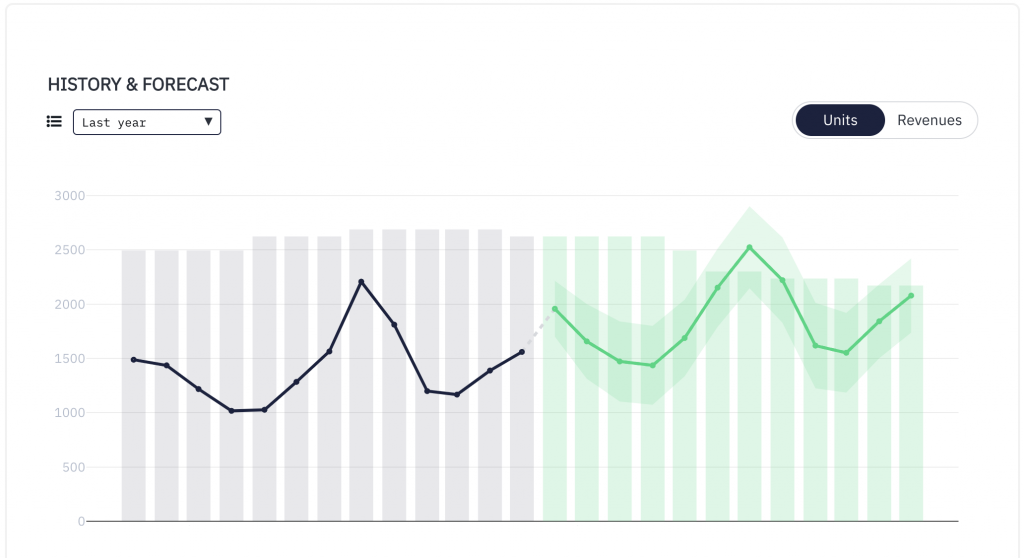
Understanding the difference between constrained and unconstrained demand is essential to choosing the forecasting method best suited to your business’s needs. Fear not: this article will delve deeper into the fundamentals of constrained and unconstrained demand analysis, how to best integrate both approaches into your decision-making processes, and outline the challenges and latest innovations in demand forecasting.
Fundamentals of Demand Forecasting
Demand forecasting is the estimation of future demand for a product or service, obtained using analytical, mathematical, and statistical techniques. It can cover the short, medium, or long term and can be conducted at different levels of aggregation, such as product, category, or sector. The main objectives of demand forecasting are numerous. In addition to those already mentioned, they include identifying the factors that influence demand, assessing the impact of market changes, analyzing product performance, and optimal resource allocation.
There are also common steps associated with the demand forecasting process. The most traditional are: defining the problem and the forecasting objective; collecting and analyzing historical data and relevant information; selecting and applying the most appropriate forecasting method; validating and refining the forecast using specific criteria and measures; and communicating and monitoring the forecast and its implications.
Demand planning techniques can be both quantitative and qualitative. Beyond the use of data, numbers, and models, it’s important to recognize the human component: demand forecasting involves analyzing people’s purchasing behavior. Qualitative methods rely on the input of experts and customers through focus groups, surveys, and market research. These methods are particularly useful for interpreting sudden changes in trends and purchasing behavior.
Now that we’ve covered the basics, let’s get to the real reason you’re reading this article, starting with an analysis of unconstrained demand.
Unconstrained demand analysis
When we consider demand that is not influenced by supply capacity or availability, and therefore reflects true market interest, we speak of unconstrained demand . This concept is often used to measure maximum sales potential and market size. Unconstrained demand analysis is therefore the process of developing a forecast of “pure” demand, that is, demand that would occur without supply constraints. This analysis can estimate the size and growth of a market and also allows for the exploration of new business opportunities. It plays a fundamental role in identifying the gap between potential and actual demand, assessing the feasibility of new product launches, and analyzing the effectiveness of existing marketing strategies.
There are three main techniques for forecasting unconstrained demand. Market analysis examines market conditions and dynamics, such as growth and competition, to estimate current and future demand. Customer analysis relies on consumer preferences and needs, collecting demographic, behavioral, and attitudinal data to forecast demand. Product analysis considers product characteristics such as quality, functionality, and differentiation to estimate future demand.
Unconstrained demand analysis has several advantages: it offers a more realistic view of consumer interest, highlights untapped growth opportunities, and helps identify potential weaknesses in marketing strategies. However, it also has limitations. Obtaining reliable data can be difficult or expensive, especially for new products. It’s complex to account for all the variables that influence demand in uncertain environments, and it doesn’t consider supply constraints, thus failing to reflect actual sales. If this last aspect is a concern, it may be helpful to consider constrained demand analysis , which we’ll address in the next section.
Constrained demand analysis
Constrained demand considers demand when it is influenced by supply capacity and availability. It focuses on realized demand and is often used to estimate sales revenue for a product or service. Constrained demand analysis is therefore the process of developing a forecast based on constrained demand. This analysis can identify the optimal production and inventory levels, essential for managing the balance between overproduction and underproduction. It also allows a company to adjust supply constraints in the forecast based on changes in demand. It also evaluates the efficiency of current operations, thus improving profitability.
As with unconstrained demand analysis, there are three main techniques in constrained demand analysis. The first is capacity analysis, which examines supply availability and its impact on production and distribution. This analysis allows you to determine how much inventory can be deployed to meet demand. The second option is resource analysis. It analyzes the inputs required to provide the product or service, including materials, equipment, and labor. It shows how resource availability affects the company’s ability to meet demand. The final option is budget analysis. This technique examines available funds, such as capital, operating expenses, and marketing, to forecast future constrained demand based on budget availability.
Constrained demand forecasting has a subcategory called sales forecasting, which is often used to predict product or service sales by analyzing historical sales data and customer behavior. When used correctly, it can help companies plan budget allocation, monitor sales performance, identify business opportunities and challenges, and set sales goals and targets. There are three main analytical methods for sales forecasting. Historical analysis uses past sales data (especially sales patterns, trends, and seasonality) to forecast future sales. Market share analysis forecasts future sales by looking at factors such as market size, growth, and competition. Salesforce opinion relies on the judgments and insights of sales representatives to estimate future sales. Representatives are selected based on their experience and market knowledge, with particular attention to their expectations for the product or service.
Using any of these constrained demand analysis techniques has numerous advantages. Companies obtain a practical demand forecast that recognizes supply constraints, helping them optimize operations. It also allows them to compare actual sales with projected targets and indicate how to maximize supply profitability. However, it is not without its challenges. It can be costly and complex to measure in complex processes. It is more difficult to avoid over- or underproduction because adjusting supply constraints requires precision. Furthermore, it does not reflect actual demand, risking missing out on customer segments not yet served.
Comparison and impact on demand forecasting
As you may have already guessed, constrained and unconstrained demand forecasting represent two starkly contrasting approaches. Each has distinct advantages and disadvantages and can be better understood by comparing them based on criteria such as accuracy, complexity, relevance, and implications.
Constrained demand forecasting is the most accurate approach, as it is based on realized demand rather than potential demand. By considering supply constraints, this method allows planning to take into account the effects these constraints will have on product demand. Conversely, unconstrained demand forecasting is more complex, as it incorporates a greater number of variables and uncertainties that influence demand—such as competitor actions—and uses more data in its analysis.
In terms of relevance, unconstrained demand forecasting is often more relevant, as it reflects real market demand, regardless of supply constraints, allowing for the identification of potential untapped opportunities.
This has different implications: unconstrained demand forecasting is geared toward exploration and innovation. It is useful for exploring new markets, launching new products, or outperforming competitors through innovative solutions. Conversely, constrained demand forecasting is geared toward optimization. It aims to improve production processes, inventory management, budget planning, and marketing strategies, with the goal of increasing efficiency and profitability.
Perhaps the best way forward is to integrate the two approaches…
Integrating constrained and unconstrained forecasts into decision making
Constrained and unconstrained demand forecasting can be different, but they aren’t necessarily mutually exclusive. Indeed, if carefully integrated, they can be highly complementary, offering different perspectives on the same situation. Below are some steps to find the right balance between the two.
The first step is to use unconstrained forecasting to estimate maximum sales potential, followed by constrained forecasting to estimate actual sales. Next, unconstrained forecasting can be used to identify the gap between potential and actual demand, while constrained forecasting helps adjust supply constraints to close that gap. Finally, unconstrained forecasting can be used to evaluate the effectiveness of current marketing strategies and optimize business operations using constrained forecasting. The final step can be to explore new markets with unconstrained forecasting and, finally, allocate resources and budgets to new product launches using constrained forecasting.
An effective example of integrating the two approaches could be a hotel chain that uses unconstrained demand forecasting to estimate potential room demand at different locations based on the seasons. The constrained forecast is then used to optimize management strategies based on actual room availability and operating capacity.
Challenges and innovations in demand forecasting
As you know, demand forecasting is a constantly evolving field, facing numerous challenges in the current business environment. Today’s customers have higher expectations, seeking personalized products and responsive services. This has led to increased market complexity and greater uncertainty regarding customer behavior and competitor actions, making demand forecasting significantly more difficult. Added to this is the growing availability and diversity of data, which requires more advanced analysis and data cleansing techniques.
Fortunately, technological innovations have evolved alongside these growing challenges. The advent of cloud computing and big data analytics has made available platforms capable of storing and sharing massive data sets, running simulations, and generating in-depth analyses. Artificial Intelligence (AI), thanks to a variety of algorithms, can analyze complex data and learn from changes in demand patterns, offering more accurate and flexible forecasts. Social media has created a space for real-time demand forecasting: by gathering feedback and opinions directly from customers, forecasts can be updated to reflect changes in public behavior or preferences.
Conclusion
Demand forecasting is a fundamental part of business strategy planning and execution, as it allows your company to optimize resources and operations to maximize sales. For this reason, it’s important to have a good understanding of both constrained and unconstrained approaches, as well as how these two methods can be combined. This knowledge will allow you to make an informed decision on the approach best suited to your company’s demand forecasting needs.
Learn how Intuendi can help you forecast both constrained and unconstrained demand.